

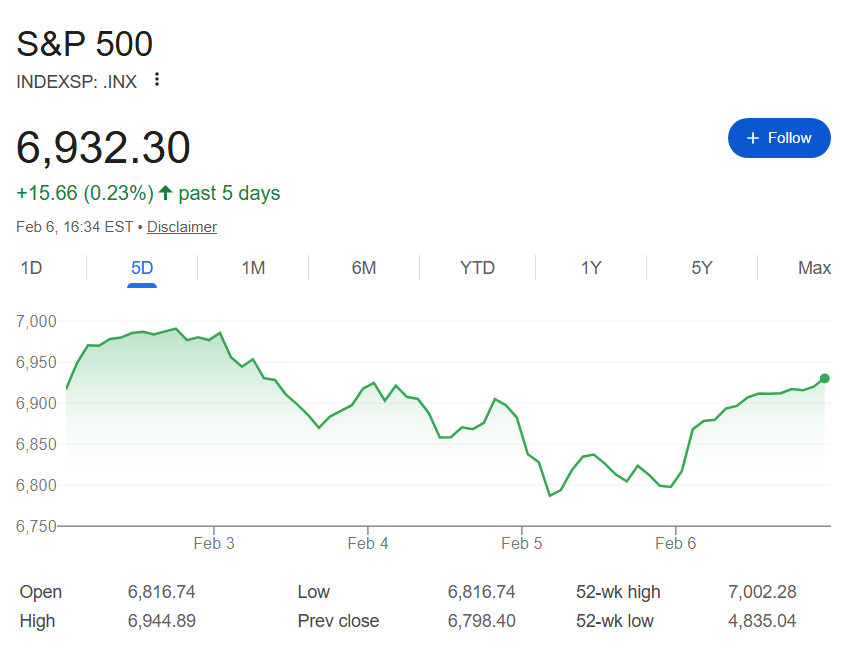
While the U.S. stock market performance on Friday, February 6, seemingly put a bullish end to a volatile week with the S&P 500 recording its biggest one-session gain since May 2025, Goldman Sachs (NYSE: GS) issued a stark warning that investors are not yet out of the woods.
According to the banking giant’s trading desk, the first week of February provided enough of a drop for trend-following algorithmic funds to continue offloading equity.
Should the downtrend resume, such funds are expected to dump approximately $33 billion worth of shares, and even a sideways market could lead to about $15.4 billion worth of selling.
Goldman Sachs simultaneously warned that thin liquidity and the dominance of net short positions are likely to magnify volatility and possibly lead to outsized losses in the second week of February.
Will the January jobs cause a stock market sell-off?
Elsewhere, the January U.S. jobs report raised the danger of a major sell-off in the coming days. Specifically, data shows that there have been more layoffs in the first month of 2026 than at the start of any year since 2009 – meaning since the Great Recession.
The 108,435 job cuts in January 2026 not only represent a 118% increase compared to the same period in 2025, but put into sharp context the prevailing pressures from the artificial intelligence (AI) boom and global trade disruptions that have taken root in recent months.
American big tech has pledged hundreds of billions of dollars in investments to AI, straining its capital reserves and causing tens of thousands of job losses since late 2025.
AI drives layoff spike with no clear path to profitability
Indeed, late last year, Amazon (NASDAQ: AMZN), UPS (NYSE: UPS), and Target (NYSE: TGT) all executed significant job cuts, while early 2026 brought a large workforce reduction in Jeff Bezos’ Washington Post and the revelation that Oracle (NYSE: ORCL) is considering firing as many as 30,000 workers.

Though mass layoffs are never welcome, the situation is only made worse by the fact that AI needs to generate trillions in revenue – a figure many experts consider impossible – by 2030 for the investments to pay off, and the fact that many of the investing agreements technology giants have unveiled appear to have disappeared in recent weeks.
Along with the semiconductor giant Nvidia (NASDAQ: NVDA) seemingly giving up on the $100 billion injection previously pledged to OpenAI, factoring in profits from deals made with AI companies has been notably absent from most of the recent forward-looking guidance publications.
The risks associated with the AI sector have also been under close scrutiny from multiple prominent market experts, with the famous ‘Big Short’ investor Michael Burry being one of the most notable voices warning of extreme overvaluation.
President Trump’s trade war at risk of collapse
Simultaneously, President Donald Trump’s tariff war has caused its own fair share of instability.
Reports from late 2025 indicate that as much as 96% of the added costs have been absorbed by American consumers, straining their ability to contribute to the national economy, while the liberal levying of dues upon allies and adversaries alike has strained trade relationships that have been developed over numerous decades.
Trade war instability has also led to additional and more recent volatility, as the policy itself is in danger of collapse should the U.S. Supreme Court finally decide to both stop postponing the long-awaited ruling and decide to declare the tariffs illegal.
Featured image via Shutterstock