

In March 2026, Google Trends offered the latest bit of evidence of the cracking U.S. housing market as search interest for the term ‘can’t sell house’ hit the highest value recorded in the chart going back to 2004 – the farthest the tool is able to provide.
Specifically, on the scale that can display values between 0 and 100, the reading stood at the highest possible number both in February and March.
Such a state of affairs represents the culmination of a trend that has been unbroken since November 2025 – when search interest was at a local low of 61 – but that has also been active since the latest major low of 26 in March of 2023.
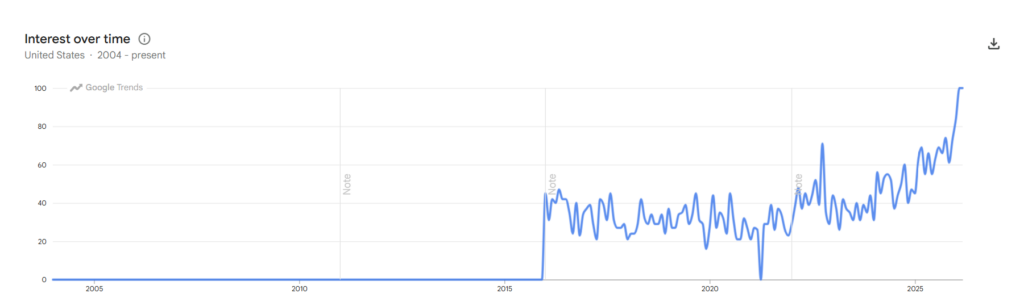
For comparison, the majority of the previous regional highs relative to the values at press time on March 18 were all in the range between 42 and 47 – with an apparent gravity at a value of 45 – and were recorded twice in 2026, and then at various points in the years 2017, 2018, 2019, and then again twice in 2020.
The previous record interest came in October 2022, when the reading shows Google searches for ‘can’t sell house’ stood at 71.
Home sellers turn to renting due to a lack of house buyers
While dramatic for how high interest has become relative to all previous peaks, the development is hardly surprising given the recent headlines regarding the American housing market.
The glut of unsold homes in the U.S. has been growing steadily, with the number of vacant properties reportedly reaching nearly 2 million and their value reaching $700 billion already in 2025.
Similarly, on March 11, Zillow revealed that the share of ‘accidental landlord’ – people attempting to sell but turning to renting due to waiting too long to find a buyer – has hit 2.3%.
While the figure might not appear high in absolute terms, it is the biggest percentage recorded in the history of the company, barring the November 2022 peak.
Data also shows that Texas is the hotbed for these ‘accidental landlords’, considering their share is the second, third, fourth, and eighth-highest in Houston, Austin, San Antonio, and Dallas, respectively.
The percentage is highest at 4.9% in Denver, Colorado.
Home buyers in short supply despite affordability improvements
Elsewhere, the mounting ‘can’t sell house’ search volume might be particularly concerning, considering it continued growing even after Redfin reported that home affordability has improved by approximtelly 4% compared to 2025.
Specifically, the company revealed on February 11 that buyers must earn $111,252 per year to be able to afford a house, while the figure stood at a high above $122,000 in June 2025, and at $115,870 one year earlier.
The drop in relative prices, however, might do little to alleviate the housing market woes, considering the recent deluge of layoffs – and the trend of employment figures getting downward revisions months after first getting unveiled – and rising mortgage prices appear poised to erode Americans’ purchasing power faster than house prices can drop.
Lastly, the situation may also present a greater systemic risk to the U.S. economy, given that a growing gap between supply and demand tends to lead to prices crashing.
With the Federal Reserve estimating that real estate accounts for about 50% of the net worth of the bottom 50% of Americans, a housing market collapse could simultaneously constitute an unprecedented erasure of wealth for tens of millions of people.
Featured image via Shutterstock