
The Coinspaid Solutions strategic leader has outlined four infrastructure decisions that shape how businesses turn crypto acceptance into everyday payments.
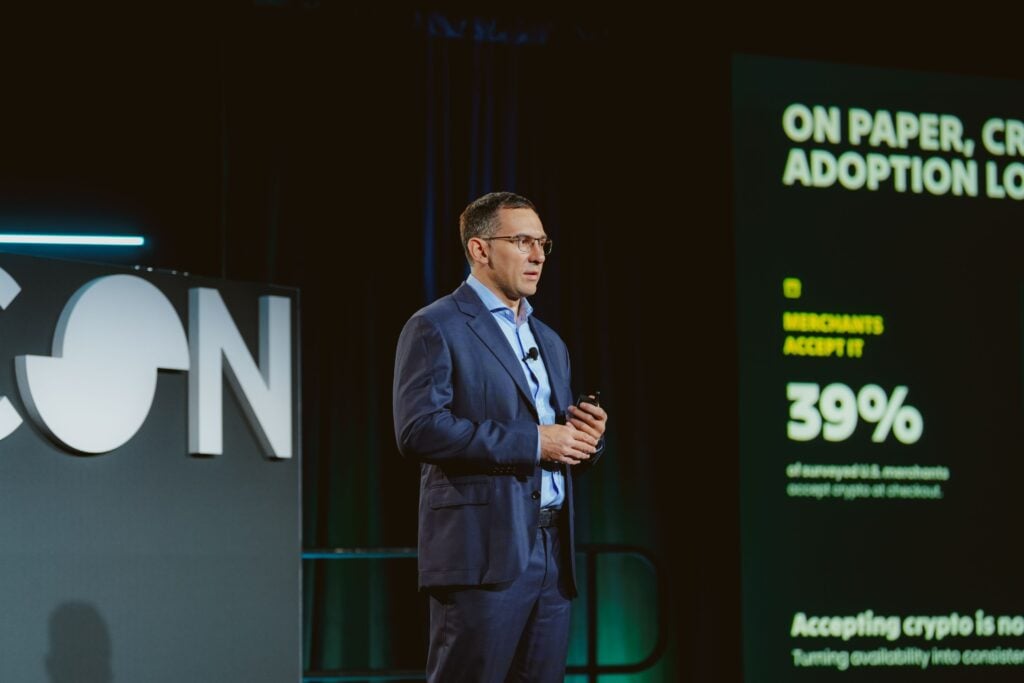
Pavel Kashuba, Strategic Leader at Coinspaid Solutions, used his main-stage address at Stablecon USA 2026 in Washington, D.C., to examine the operational work required to make crypto a routinely used payment method.
His session, “Four in Ten American Businesses Take Crypto. Most of Their Customers Never Notice,” placed payment design at the center of the adoption debate. Kashuba argued that availability alone provides a limited measure of success. Real adoption appears in completed transactions and repeat customer behavior.
Adoption is already visible at checkout
A Harris Poll survey for the National Cryptocurrency Association found that 39% of surveyed U.S. merchants accept crypto at checkout. Among those merchants, crypto represents 26% of total sales. Another NCA study found that 26.8 million Americans use crypto to shop and pay, equivalent to 40% of U.S. crypto holders.
Kashuba placed these figures within the wider stablecoin economy. A McKinsey analysis conducted with Artemis estimated annual stablecoin activity at up to $35 trillion. Actual stablecoin payments ran at about $390 billion based on December 2025 activity, leaving payment use at roughly 1% of total volume.
For Pavel, this gap shifts attention toward the practical conditions surrounding each payment.
Four decisions determine real usage
Kashuba organized the challenge around four operational decisions. Placement determines whether customers see the crypto option at checkout. Currency and network coverage influence transaction cost and processing time. Settlement design governs when merchants receive funds and the form in which they arrive. Custody establishes who controls the assets and carries responsibility for them.
For banks, PSPs and acquirers, these are the design choices behind any crypto offering they extend to their merchants.
The framework draws on the operating experience behind Coinspaid Solutions. Infrastructure used by its clients has processed more than €100 billion in volume and over 200 million transactions.
At that scale, checkout visibility and network selection have measurable effects on payment completion. Settlement configuration shapes the merchant’s exposure after each transaction. Kashuba’s approach gave the session an operational basis grounded in live payment environments.
Settlement and custody define the operating model
More than 70% of businesses settle crypto payments in fiat, according to figures presented by Kashuba. Configured for automatic conversion into U.S. dollars or euros, the setup lets merchants receive familiar treasury assets without holding crypto. Settlement is provided by regulated entities or licensed banking partners; availability varies by jurisdiction. Blockchain transfers operate outside the card chargeback mechanism, while refunds remain a separate merchant-controlled process.
Custody carries a wider set of operational consequences. “The choice depends on how much control your business wants and how much infrastructure it can manage,” Kashuba said.
This division of responsibility is also central to the enterprise infrastructure model developed by Coinspaid Solutions. Financial institutions operate under their own regulatory framework and retain control over transaction signing. Coinspaid deploys and maintains the underlying technology, allowing institutions to preserve their customer relationships and operating models. The structure reflects Kashuba’s broader point that control, security, compliance and operational capacity need to be designed as one system.
A framework for agentic payments
Pavel Kashuba closed by applying the same framework to agentic payments. Amazon’s Buy for Me and Google’s Universal Cart already allow AI systems to complete purchases for users. The x402 protocol has recorded more than 100 million transactions on Base. Autonomous commerce will still depend on visible payment options, suitable network coverage, reliable settlement and clearly assigned custody. Kashuba presented the experience gained from live crypto payment infrastructure as a practical foundation for designing that emerging layer.
Across the session, Kashuba’s central message remained grounded in execution: payment infrastructure creates value when it converts market demand into reliable, repeatable usage. Coinspaid Solutions’ experience at scale gave that argument a practical foundation, connecting today’s crypto payment realities with the infrastructure requirements of the next phase of digital commerce.
Featured image via Coinspaid Solutions.