

Micron (NASDAQ: MU) has been one of the most successful artificial intelligence (AI) companies this year, and $1,000 investment in Micron stock at the start of 2026 would have yielded exceptional profits.
Namely, on January 2, 2026, the first trading session of the year, Micron shares were trading at $315. By press time, June 30, 2026, the stock had surged to $1,145, marking a more or less 263% gain during a period of six months.
As a result, a $1,000 Micron investment at the start of 2026, which would have allowed you to purchase just about three shares, would be worth approximately $3,635 today, netting you $2,635 in profits.
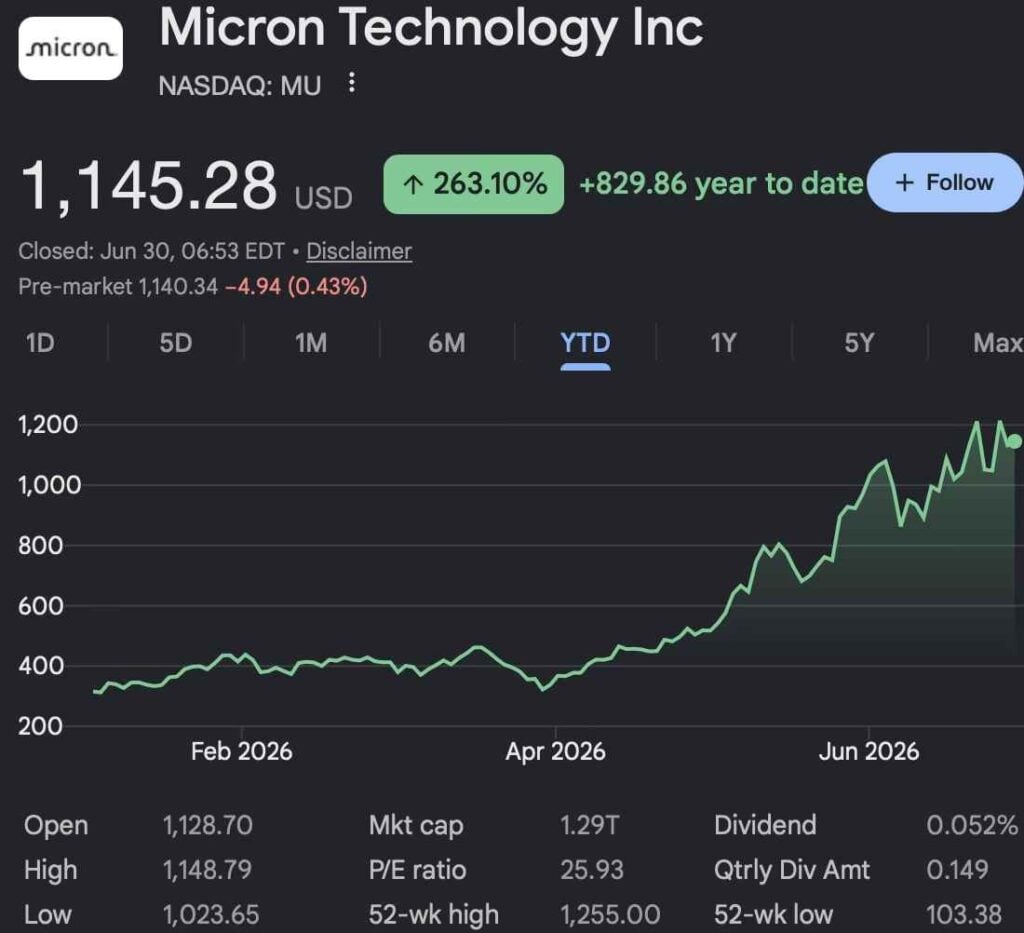
Micron stock continues to rally
Micron’s extraordinary performance has been fueled by surging demand for high-bandwidth memory (HBM) and advanced DRAM chips. As hyperscalers and developers continue investing heavily in data centers, Micron has emerged as one of the sector’s biggest winners, with its HBM chips becoming essential to the AI infrastructure.
The company has also strengthened its revenue outlook by securing long-term supply agreements, with management confirming that its entire HBM production capacity for 2026 has already been sold. At the same time, the rollout of next-generation HBM4 memory has further reinforced the company’s position as a key supplier.
Financial results have provided another major tailwind for the stock. Notably, in its fiscal third quarter ended May 28, 2026, Micron reported revenue of $41.46 billion, 84.6% higher than the previous one.
Of course, the rapid ascent has also increased volatility, with some investors worrying that Micron could face a sharp pullback if the semiconductor memory market enters another downcycle. Still, analysts such as C.J. Muse from Cantor Fitzgerald, whose Micron stock price target now sits at $2,000, argue that Micron’s business model has given it a lot more room to run.
Should Muse’s bullish predictions come true, our hypothetical $1,000 investment in Micron at the start of 2026 will be worth about $6,340 within the next twelve months.
Featured image via Shutterstock