
American semiconductor giant Intel (NASDAQ: INTC) is closing in on overtaking Oracle (NASDAQ: ORCL) in market capitalization, with the gap between the two technology companies narrowing to just over $8 billion.
Based on market closing data for May 15, Intel held a valuation of approximately $546.67 billion, compared to Oracle’s $554.93 billion, a difference of $8.26 billion.
The gap places Intel at rank 23 among the largest U.S. companies, directly behind Oracle at rank 22.
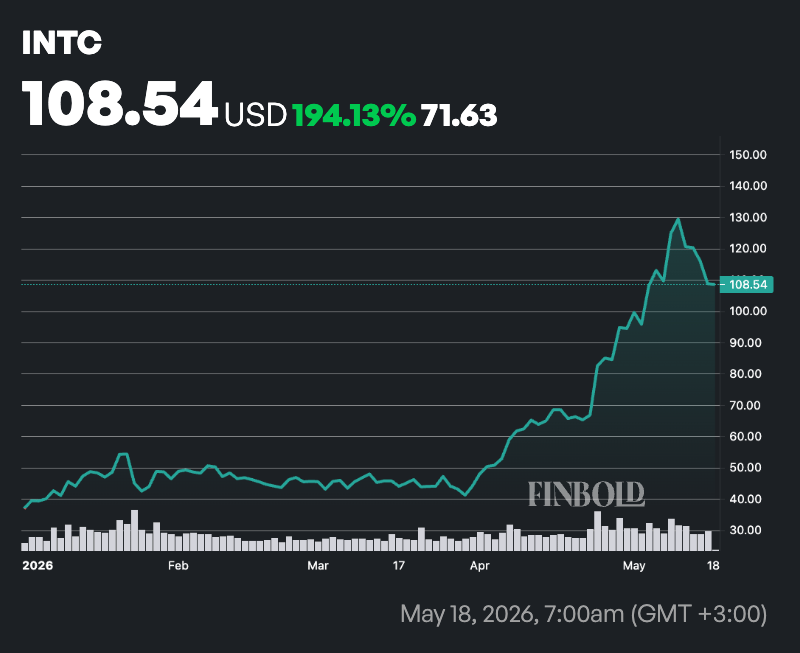
The narrowing difference reflects Intel’s dramatic resurgence in 2026, with the chipmaker’s stock rallying almost 200% year-to-date. As of press time, INTC shares were trading at about $108.
A major driver behind the rally has been Intel’s strong first-quarter 2026 earnings report. The company posted revenue of $13.6 billion, beating guidance by roughly $1.4 billion.
Intel’s data center and AI segment revenue rose 22% year-over-year, while AI-related businesses now account for nearly 60% of total revenue after expanding 40% annually.
The report also showed improving profitability, with adjusted gross margins climbing to about 41%, supported by stronger factory yields, tighter cost controls, and improved manufacturing execution.

At the same time, Intel’s advanced 18A process node is reportedly progressing ahead of schedule, with improving yields expected to support higher margins and faster production ramps.
Additional momentum has come from Intel’s expanding foundry business and high-profile partnerships. Reports of a preliminary chip-making agreement with Apple (NASDAQ: AAPL) fueled double-digit gains in Intel shares, as investors viewed the deal as a major step toward expanding U.S.-based manufacturing and reducing Apple’s reliance on TSMC.
Intel has also expanded AI infrastructure collaborations with Tesla (NASDAQ: TSLA), Alphabet (NASDAQ: GOOGL), Microsoft (NASDAQ: MSFT), and Amazon (NASDAQ: AMZN).
The case for Oracle stock
Meanwhile, Oracle continues to benefit from strong demand for its cloud infrastructure and AI-related services. The company reported remaining performance obligations of $553 billion, highlighting substantial contracted demand from hyperscale customers building AI infrastructure.
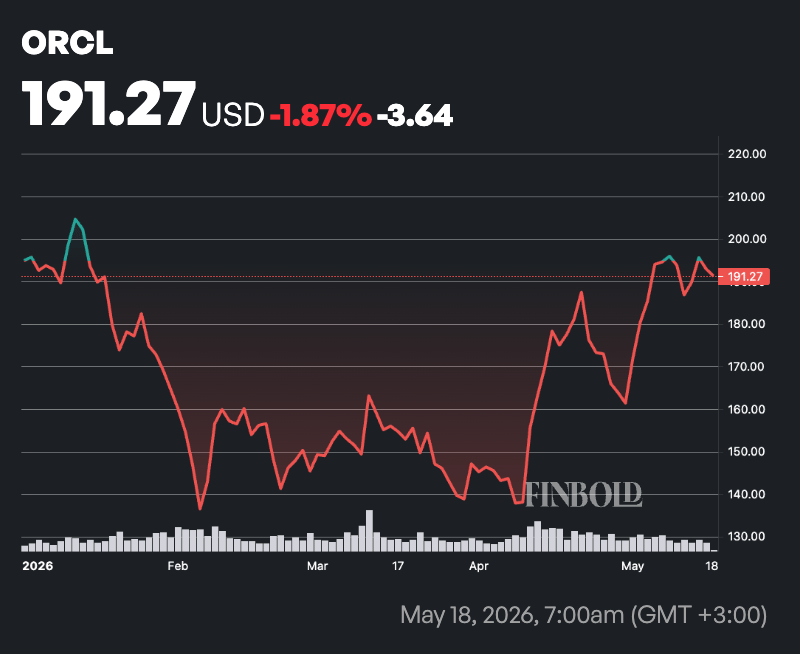
Oracle’s cloud infrastructure business has continued growing rapidly, supporting stronger guidance for the year. However, ORCL shares have faced modest pressure, where they are down about 1.8% year-to-date, trading at $192.
Overall, the close market cap race highlights shifting dynamics across the AI sector, with Intel benefiting from renewed confidence in semiconductor manufacturing and AI hardware infrastructure, while Oracle remains a key player in enterprise AI cloud spending.