
AIR Kit is a modular SDK built on Moca Network that gives platforms a plug-in layer for verifiable identity, embedded payments, and loyalty mechanics through a single integration. This review covers its three core modules alongside use cases, security, and how to get started.
What is AIR Kit?
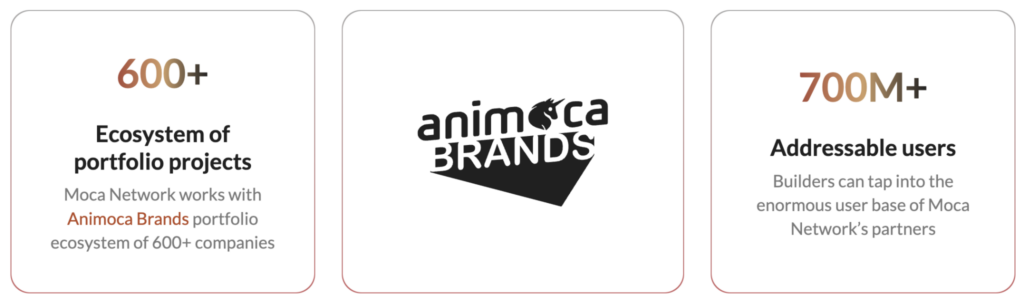
AIR Kit is a modular software development kit (SDK) built on Moca Network, designed to give platforms a plug-in layer for identity, payments, and loyalty without building each from scratch. It is developed by Moca Network, which is backed by Animoca Brands, one of the largest Web3 investment and development companies globally with a portfolio of 600+ companies and 700 million+ addressable users across its ecosystem.
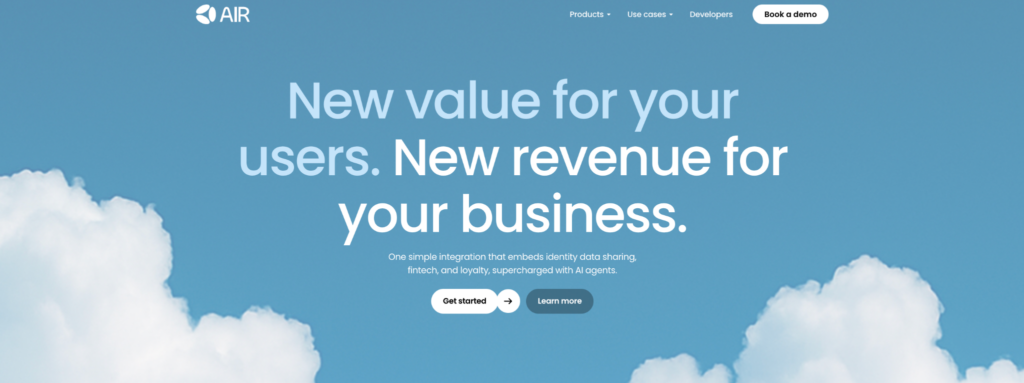
The kit is structured around three independent modules, each of which can be deployed separately or together through a single SDK integration: AIR Identity, AIR Money, and AIR Loyalty. Moca Network states platforms can go live in two to four weeks.
AIR Kit is positioned as infrastructure for platforms that want to add verifiable identity credentials, embedded financial services, or stable-value loyalty mechanics to their existing products, without requiring their users to have prior crypto knowledge or wallets.
AIR Kit modules
AIR Kit is built around three independent modules: AIR Identity, AIR Money, and AIR Loyalty. Each can be deployed on its own or combined through a single SDK integration, depending on what a platform needs.
AIR Identity
AIR Identity is the foundational module of AIR Kit and the entry point for every integration.
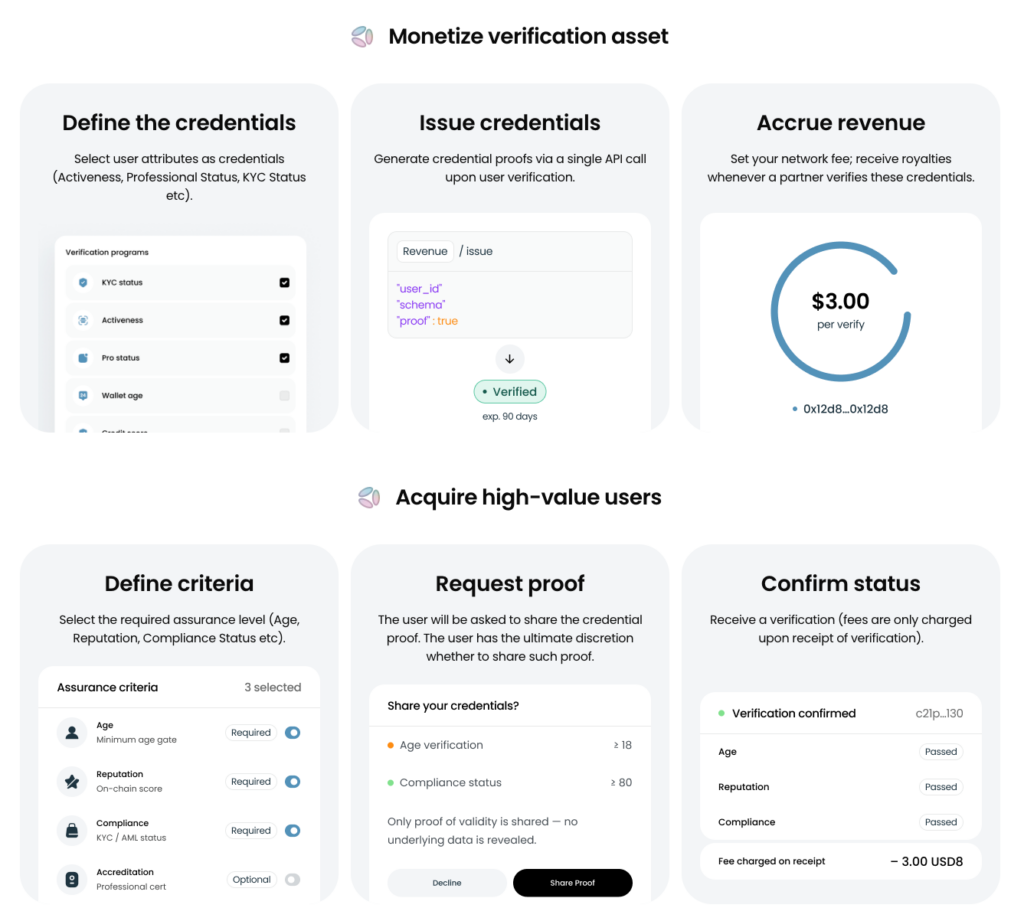
The module serves two primary goals. The first is monetizing verification assets: platforms define the credentials they hold, such as Know Your Customer (KYC) status, activeness, pro status, or wallet age, issue credential proofs via a single API call upon user verification, and earn a network fee every time a partner verifies those credentials.
The second is acquiring high-value users: platforms can define assurance criteria such as age, reputation, and compliance status, request a proof from the user, and receive a confirmed verification. The user has full discretion over whether to share their proof, and fees are only charged upon receipt of a successful verification.
The module includes five core components:
- Single sign-on (SSO): Connect existing authentication systems or use AIR Account for built-in email and social login. Users authenticate once and navigate seamlessly across the entire ecosystem;
- Verify credentials without accessing raw data: User data is turned into trusted proofs. Other businesses confirm what they need to know without accessing the raw information;
- Digital wallet integration: AIR Identity can provision users with a self-custodial, chain-agnostic wallet that stores verifiable credentials and identity data not tied to any single blockchain or verification provider;
- Plug and play deployment: Deploy under your own brand with zero disruption to the user experience, going live within days through a single SDK integration;
- Agentic identity layer: AI agents are equipped with verifiable credentials to authenticate, transact, and act on behalf of users, governed by user-approved mandates and zero-knowledge proofs.
AIR Identity is not limited to KYC. Credentials can be created for anything verifiable, including loyalty tiers, gaming achievements, employment status, event access passes, social proof, and finance-related attributes such as accreditation and income thresholds.
AIR Money
AIR Money is a modular SDK that connects platforms to licensed third-party fintech service providers through a single integration, covering global settlements, programmable payouts, card issuance, on/off-ramp connectivity, and rewards.
It is a technology layer only: all financial services are delivered through licensed, regulated third-party providers in supported jurisdictions. Platforms do not need to hold their own financial licences to deploy AIR Money, though the page notes that requirements vary by jurisdiction and module, and independent legal advice should be sought for specific use cases. End users can transact entirely in fiat or loyalty points, the underlying infrastructure is invisible to them.
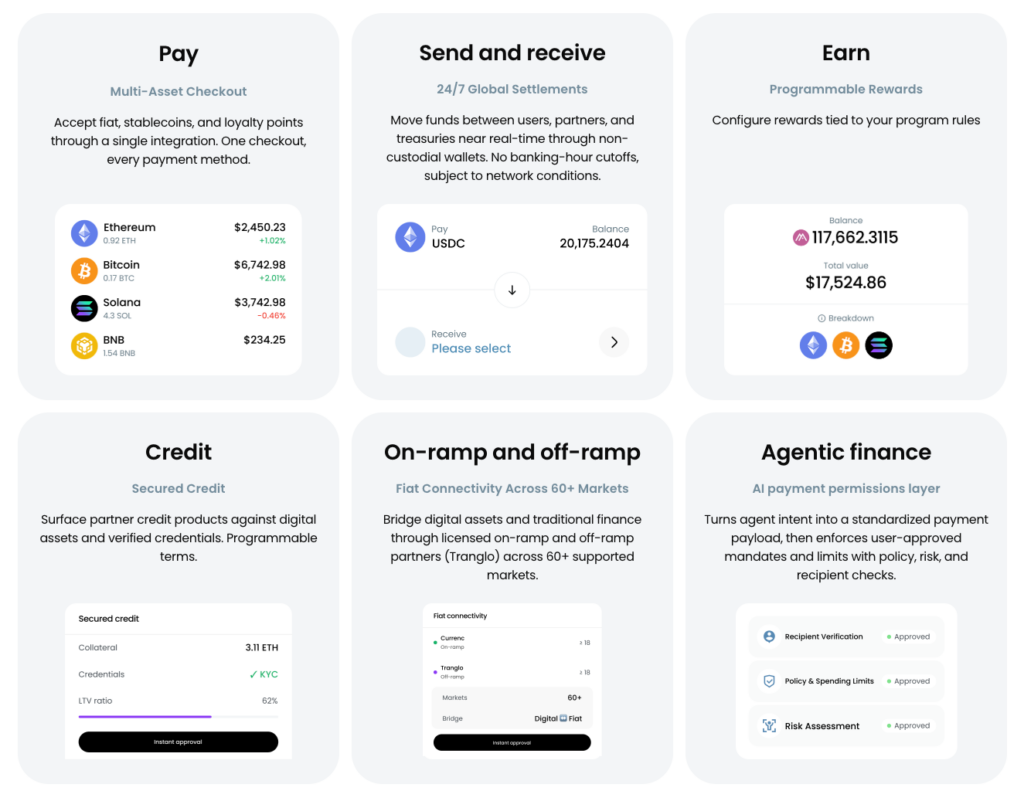
The module covers six core capabilities:
- Pay (Multi-Asset Checkout): Accept fiat, stablecoins, and loyalty points through a single integration, covering every payment method;
- Send and receive (24/7 Global Settlements): Move funds between users, partners, and treasuries near real-time through non-custodial wallets, with no banking-hour cutoffs, subject to network conditions;
- Earn (Programmable Rewards): Configure rewards tied to platform program rules;
- Credit (Secured Credit): Surface partner credit products against digital assets and verified credentials, with programmable terms;
- On-ramp and off-ramp (Fiat Connectivity Across 60+ Markets): Bridge digital assets and traditional finance through licensed on-ramp and off-ramp partners (Tranglo) across 60+ supported markets;
- Agentic finance (AI Payment Permissions Layer): Turns agent intent into a standardized payment payload, then enforces user-approved mandates and limits with policy, risk, and recipient checks.
Key platform benefits include near-real-time settlement that eliminates T+2 delays, cross-border settlement across 80+ countries, and access to the Moca Network’s 700M+ user ecosystem from day one.
AIR Loyalty
AIR Loyalty is a loyalty infrastructure module designed to create a rewards loop that drives real spending and keeps users coming back. It addresses three core problems with traditional loyalty programs: unpredictable point value, limited redemption options, and manual management overhead.
The module is built around AIR SP (Stable Points), a stable-value loyalty currency where 100 SP = $1 USD, with a fixed conversion rate that never changes. This gives users a transparent, predictable rewards asset rather than points whose value fluctuates or depreciates over time.
The module includes six core components:
- AIR SP (Loyalty points): Turn everyday loyalty points into a stable-value asset with a fixed 100 SP to $1 conversion rate;
- AIR Shop (Redemption everywhere): Users can spend points across 2M+ merchants including travel, shopping, and dining. Higher membership tiers unlock up to 31% cashback, establishing the program as a high-value user asset. No partnership work required;
- Attribution and automation: Automate rewards for any user action with rules, conditions, and event-based triggers. Keeps attribution accurate and ensures no reward is missed;
- Reward funding engine: Fund points, tier benefits, and time-bound campaigns from stablecoin reserves. Turn loyalty from a cost line into a revenue lever;
- AI reward orchestrator: Adapt earn rates, targeting, and tier offers by segment. Flags anomalies and recommends next-best incentives;
- Earn and burn logic: Set earn rates by action, tier, and product. Enforce clear redemption rules including minimum spend, eligible categories, and flexible pricing. Add expiry, reversals, and fraud checks so every point is tracked from start to finish.
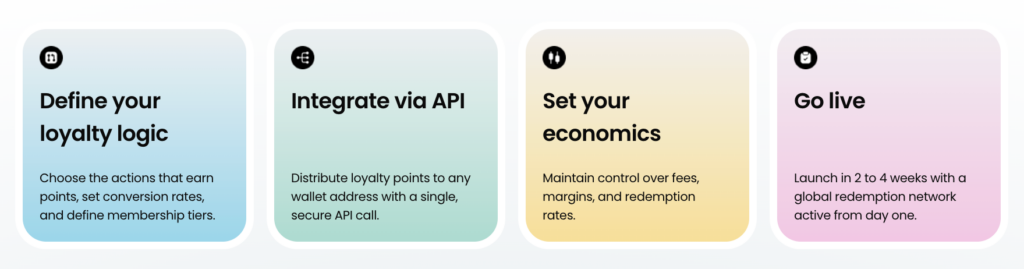
Deployment follows four steps: define your loyalty logic, integrate via Application Programming Interface (API), set your economics, and go live. The page states platforms can launch in two to four weeks with a global redemption network active from day one.
On the trust and security side, AIR Loyalty is built on institutional data security using privacy-preserving architecture designed to support General Data Protection Regulation (GDPR) and System and Organization Controls (SOC) 2 obligations, delivered through licensed third-party providers in supported jurisdictions.
AIR Kit use cases
AIR Kit targets three primary use case verticals:
Travel and loyalty
AIR Identity helps travel and loyalty programs monetize member data or recognize VIPs from partner programs without building new integrations.
The module serves two paths: monetizing loyalty data, where platforms earn a fee every time a partner confirms a member’s status, and recognizing VIPs without new integrations, where platforms accept credentials travelers already hold and upgrade their experience with no bilateral agreements or data storage required.
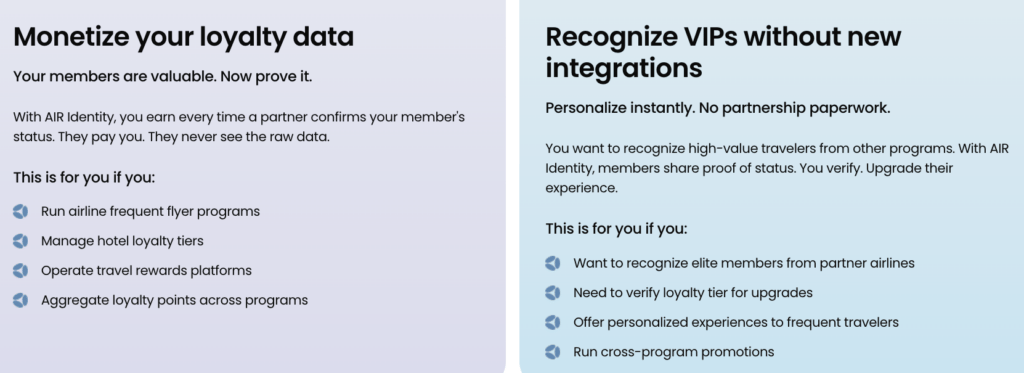
Relevant platforms include airlines, hotel chains, loyalty aggregators, Online Travel Agency (OTA) platforms, lounge operators, car rental companies, and restaurants.
Fintech and payment
AIR Identity helps fintech platforms and exchanges monetize KYC data or onboard a specific demographic of users in a streamlined manner. Again two paths: monetizing KYC investment, where platforms earn fees every time another financial service confirms something about their verified users without seeing raw data, and verifying users without running KYC, where platforms accept credentials users already have and get a compliant yes/no confirmation without storing Personally Identifiable Information (PII) or incurring ongoing compliance costs.
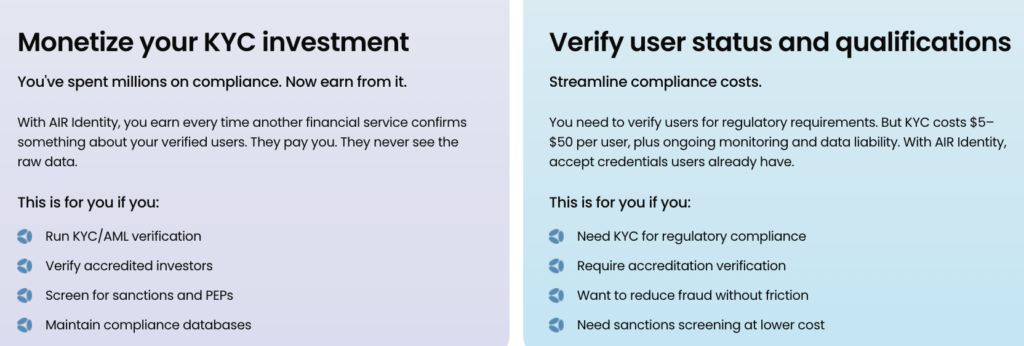
Benefits include 80% lower KYC cost, zero data custody, faster onboarding, and audit-ready cryptographic proof of verification. Relevant platforms include Decentralised Finance (DeFi) platforms, exchanges, lending platforms, and investment platforms. The page notes KYC costs $5 to $50 per user to run, takes days to process, and creates ongoing data liability. Partners confirmed: zkMe and Moca Chain.
Advertising
AIR Identity helps publishers monetize first-party audience data or reach verified audiences without third-party cookies or shadow profiles. Two paths: monetizing first-party data, where platforms earn fees every time an advertiser targets their verified segments without seeing user data, and targeting audiences without surveillance, where advertisers reach users based on verified credentials they choose to share, with zero reliance on cookies or device fingerprinting.
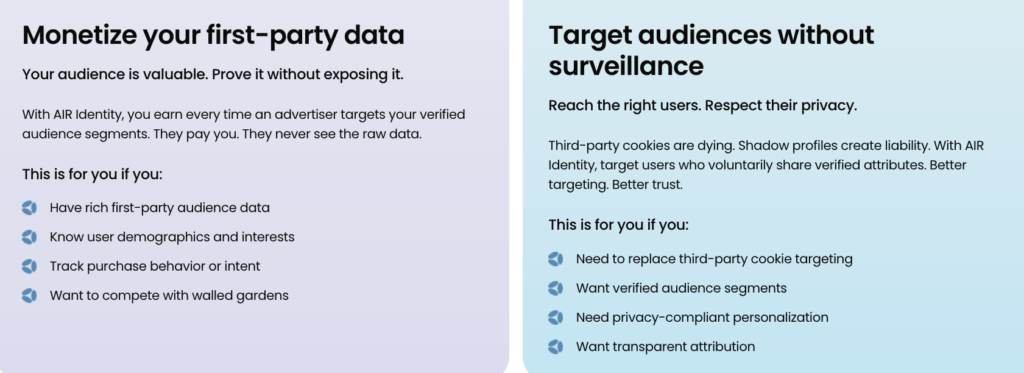
Key benefits include verified targeting based on confirmed attributes, privacy by design with user consent and GDPR and California Consumer Privacy Act (CCPA) compliance, cookie-independence, and transparent attribution with deterministic matching. Relevant platforms include brand advertisers, agencies, Demand-Side Platforms (DSPs), and retail media. Partners confirmed: zkMe and Moca Chain.
How to get started with AIR Kit
AIR Identity is the required starting point for every AIR Kit integration. Once it is in place, platforms can expand to AIR Money and AIR Loyalty through the same single SDK without additional integration overhead.
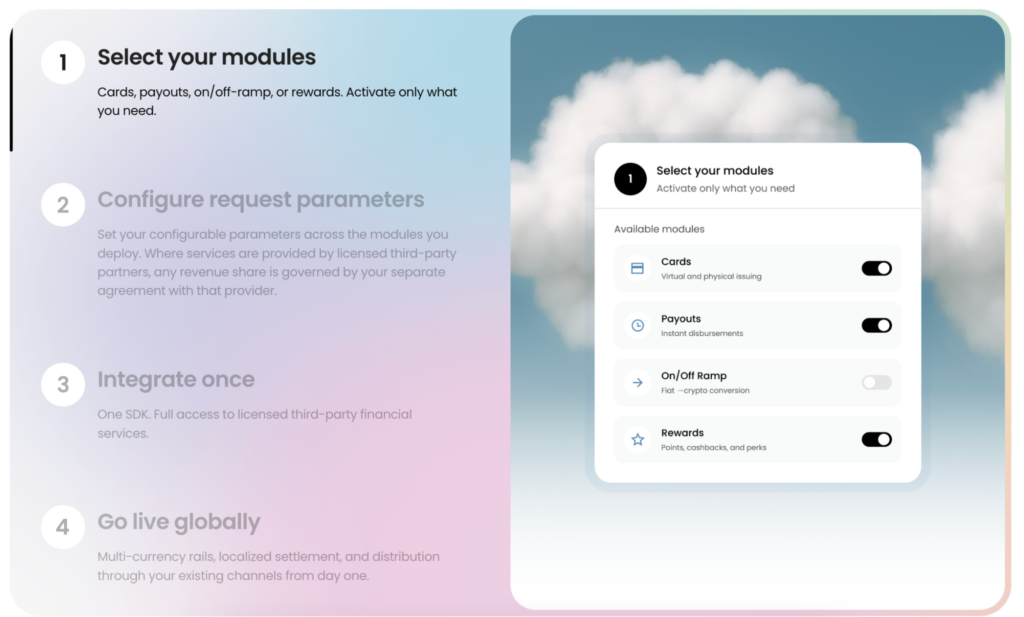
The general setup process follows four steps:
- Select your modules: Choose which capabilities to activate from AIR Identity, AIR Money, and AIR Loyalty. Cards, payouts, on/off-ramp, rewards, and loyalty logic can all be toggled on independently. Activate only what you need;
- Configure your parameters: Set your configurable parameters across the modules you deploy, including spend rules, reward economics, and redemption logic. Where services are provided by licensed third-party partners, any revenue share is governed by a separate agreement with that provider;
- Integrate once: One SDK gives access to all activated modules. Integration is designed to take days, with most partners going live within days of starting with one capability and expanding later;
- Go live globally: Multi-currency rails, localized settlement, and distribution through existing channels from day one.
To get started, platforms can book a demo directly at air3.com or read the developer documentation at docs.moca.network.
Is AIR Kit safe?
AIR Kit is built on a privacy-first architecture where encryption, user consent, and zero-knowledge proofs keep identity systems aligned with evolving regulations without exposing or centralizing user data.
Technical architecture
Four core security properties underpin the system:
- Encrypted, decentralized by design: Credentials are encrypted and stored across decentralized Moca Chain nodes. Credentials are encrypted and stored using a decentralized architecture designed to prevent unauthorized access;
- User-owned data and explicit consent: Users approve every data request. When access is revoked, keys are destroyed, making data permanently inaccessible. Control stays with the user at all times;
- Zero-knowledge verification: Attributes such as age or eligibility are verified without exposing raw data. Only a yes/no proof is shared;
- Built on global identity standards: Interoperable and portable, designed to connect to existing login systems and stay aligned with evolving global regulations.
Compliance infrastructure
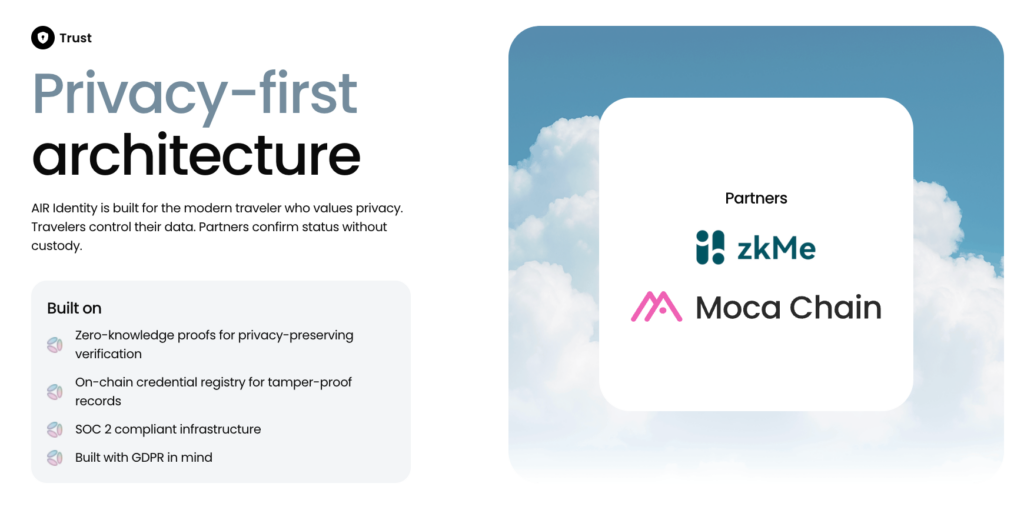
Across all three modules, AIR Kit is built on the following stack: zero-knowledge proofs for privacy-preserving verification, an on-chain credential registry for tamper-proof records, SOC 2 compliant infrastructure, and GDPR-minded architecture. Key infrastructure partners are zkMe and Moca Chain.
For AIR Money specifically, all financial services are delivered through licensed, regulated third-party providers in supported jurisdictions. The data privacy layer is built to support GDPR and SOC 2 obligations, with user identity verified without exposing or storing raw personal data.
It should be noted that AIR Kit’s architecture is privacy-first by design, but independent legal advice should be sought to ensure that any specific use of AIR Kit complies with the data protection laws and regulations applicable to the platform deploying it.
AIR Kit support, community, and social media
Platforms and developers looking to integrate AIR Kit can book a demo directly at air3.com/partner-with-us, where the AIR Kit team can walk through capabilities and integration options. Most partners go live in two to four weeks. For technical queries, full developer documentation is available at docs.moca.network.
AIR Kit and Moca Network are present on the following platforms:
Users can also subscribe to the Moca Network newsletter for the latest features and releases here.
Conclusion
AIR Kit is a well-rounded modular SDK with a lot to offer platforms looking to add identity verification, embedded payments, or loyalty mechanics without having to build each from scratch. The three-module structure is genuinely flexible, and the privacy-first architecture addresses real compliance concerns for platforms operating under GDPR and CCPA.
There are some limitations worth keeping in mind. AIR Identity is a prerequisite for everything else, so platforms cannot access AIR Money or AIR Loyalty without first integrating the identity layer. AIR Money is also a technology layer only, meaning the availability of financial services depends on licensed third-party partners and varies by jurisdiction. Pricing is not publicly listed, and platforms will need to book a demo to understand costs.
That said, for platforms in travel, fintech, advertising, gaming, or events that need a privacy-compliant, modular identity and payments infrastructure connected to a 700M+ user ecosystem, AIR Kit is a strong option worth evaluating.
Disclaimer: The content on this site should not be considered investment advice. Investing is speculative. When investing, your capital is at risk.
FAQs about AIR Kit
What is AIR Kit?
AIR Kit is a modular SDK that allows platforms to embed identity verification, global payments, and loyalty mechanics into their products through a single integration. It is built on Moca Network and consists of three modules: AIR Identity, AIR Money, and AIR Loyalty.
What is AIR Identity?
AIR Identity is a verifiable credential system that allows platforms to issue and verify digital proofs about their users without accessing or storing raw personal data. It is the foundational module of AIR Kit and the required starting point for every integration.
Is AIR Identity only for KYC?
No. KYC is one use case. Credentials can be issued for anything verifiable, including loyalty tiers, gaming achievements, employment status, event access, social proof, and financial attributes such as accreditation and income thresholds.
What is AIR Money?
AIR Money is a modular SDK that gives platforms access to global settlements, programmable payouts, card issuance, on/off-ramp connectivity, and rewards through a single integration. It is a technology layer only, i.e., all financial services are delivered through licensed, regulated third-party providers.
Do platforms need their own financial licences to use AIR Money?
No. Financial services are provided by licensed third-party partners. However, requirements vary by jurisdiction and module, and independent legal advice should be sought for specific use cases.
Is AIR Money only for crypto platforms?
No. End users can transact entirely in fiat or loyalty points. The underlying infrastructure is invisible to them.
How long does integration take?
Most partners go live within days of starting with a single capability and expand from there.
Is AIR Kit compliant with privacy laws?
The architecture is privacy-first by design, but platforms are responsible for ensuring their specific use of AIR Kit complies with the data protection laws applicable to their jurisdiction. Independent legal advice is recommended.