
GoBTC Pay is a Bitcoin payment protocol built by GoMining that lets users spend Bitcoin at merchants instantly, with zero fees and no fiat conversion. This review covers how it works, its fee model, security architecture, and who it is built for.
What is GoBTC Pay?
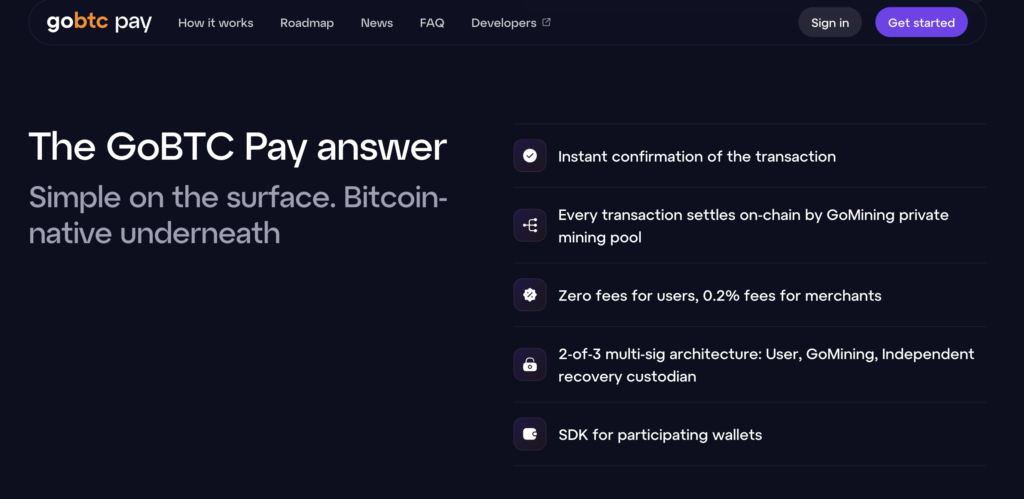
GoBTC Pay is a Bitcoin Layer-1 payment protocol launched by GoMining in May 2026. It is designed to let users spend Bitcoin (BTC) at merchants instantly and on-chain, with zero fees for users and without converting to fiat at the point of sale. Early access opened on June 19, 2026, with the protocol available to both merchants and wallet providers.
The product is built on GoMining’s existing infrastructure. Founded in 2021, GoMining is a Bitcoin mining company that has built a community of over 5 million users and operates data centres across North America, Africa, and Central Asia.
The company is one of the top 10 Bitcoin miners globally by hashrate, with a team of 300+ people working across North America, Europe, and Asia. Its broader ecosystem spans digital mining, a wallet, crypto cards, Bitcoin-backed lending, and a Simple Earn product.
GoBTC Pay is the payments layer within that ecosystem, and also the piece that GoMining is positioning as open infrastructure for the wider market. The current roadmap runs from a merchant POS, dashboard, and SDK already in progress, through P2P payments and a fiat off-ramp, to an open payment rail for any wallet or merchant.

How GoBTC Pay works
GoBTC Pay operates on Bitcoin’s base layer, using GoMining’s own private mining pool to enable instant payment confirmation without Lightning Network channels, wrapped tokens, or fiat conversion at checkout.
The payment flow works as follows:
- A user pays at a GoBTC-enabled merchant using Bitcoin from a compatible wallet;
- The transaction is broadcast directly to GoMining’s dedicated mining pool;
- The pool prioritises the transaction for inclusion in the next block;
- The merchant sees instant confirmation at the point of sale.
The key to the model is GoMining’s control over its own mining infrastructure. Most Bitcoin payment providers depend on third-party mining pools to get transactions confirmed, which means they have no control over confirmation times and pay full network fees on every transaction.
Because GoMining mines its own blocks, it can prioritise GoBTC transactions and recapture the network fee through its own pool participation, a closed-loop model that payment-only companies cannot replicate without owning mining infrastructure at scale.
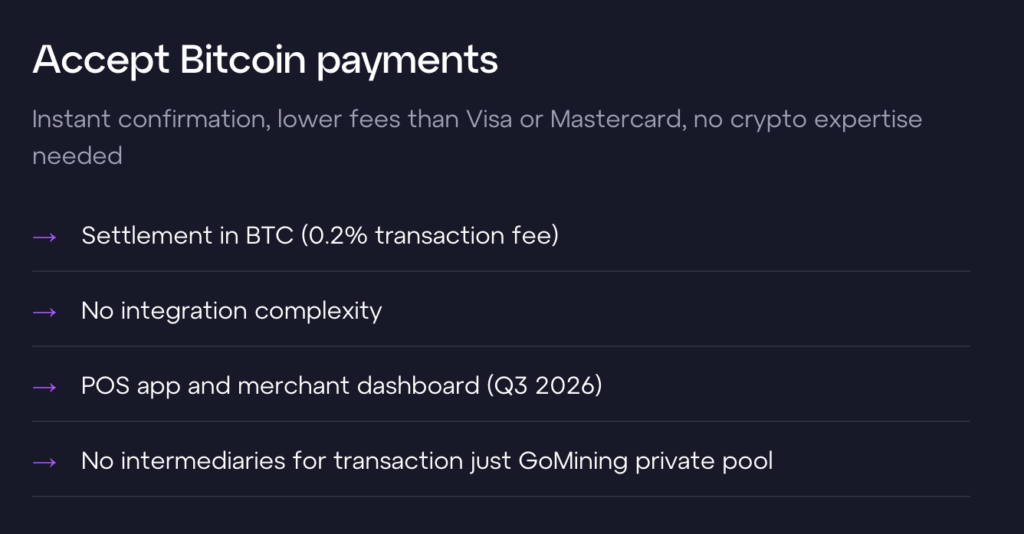
Merchants receive settlement that is final and irreversible. Unlike card payments, where merchants face chargeback risk for weeks or months after a sale, GoBTC transactions cannot be reversed once settled on-chain. There are no chargebacks, no dispute windows, and no rolling reserves.
How to get started with GoBTC Pay
The GoBTC Pay app is available on both iOS and Android. Setup follows the same steps as a standard Bitcoin wallet: download the app, back up your seed phrase, and optionally set up a PIN and biometric access such as Face ID.
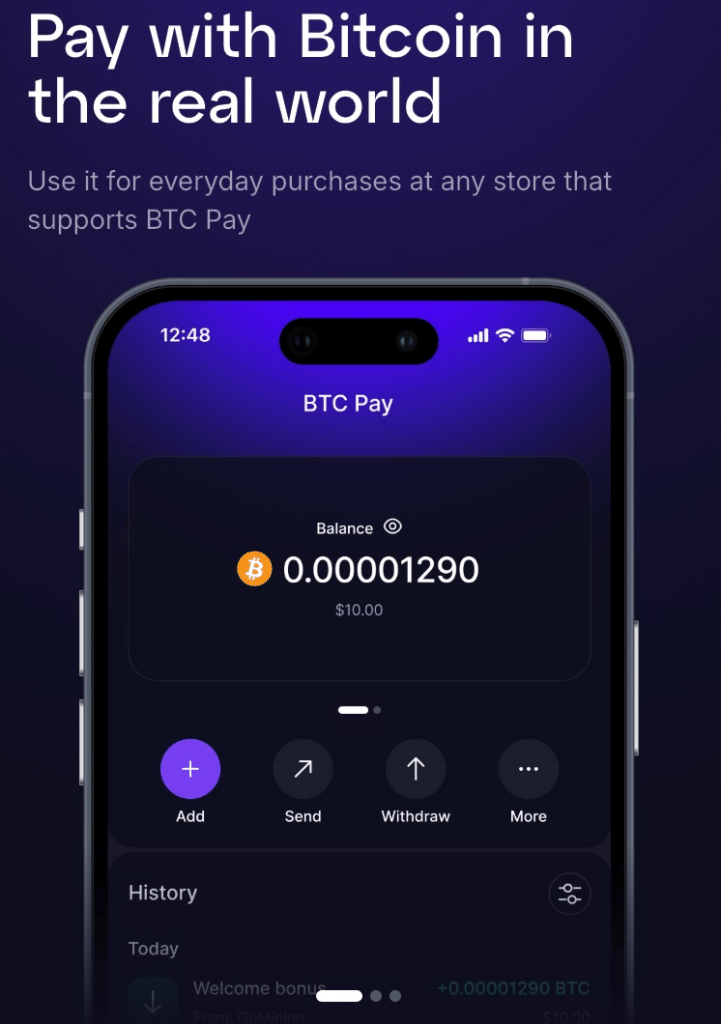
Step 1: Set up your wallet. Once set up, the app splits into two separate balances: a regular non-custodial Bitcoin wallet for holding funds, and a BTC Pay wallet for spending. The BTC Pay wallet is the one connected to the GoBTC Pay protocol and its instant payment system. Fund it with the amount you plan to use for near-term payments.
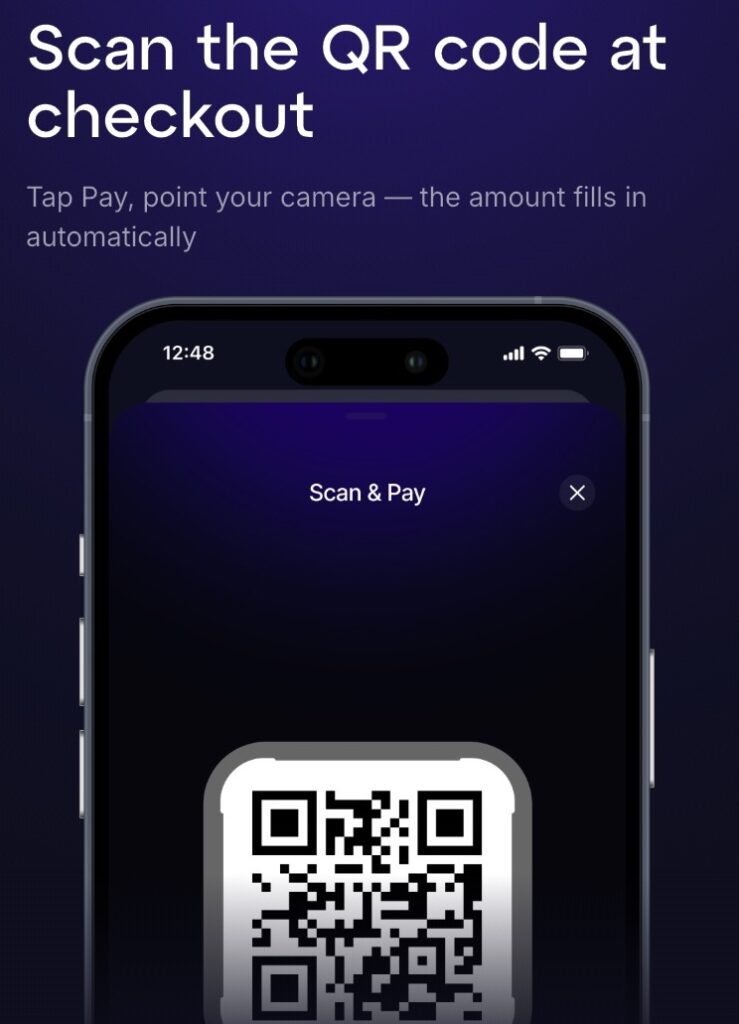
Step 2: Scan the QR code at checkout. To make a payment, open the BTC Pay tab, tap Pay, and point your camera at the merchant’s QR code. The amount fills in automatically.
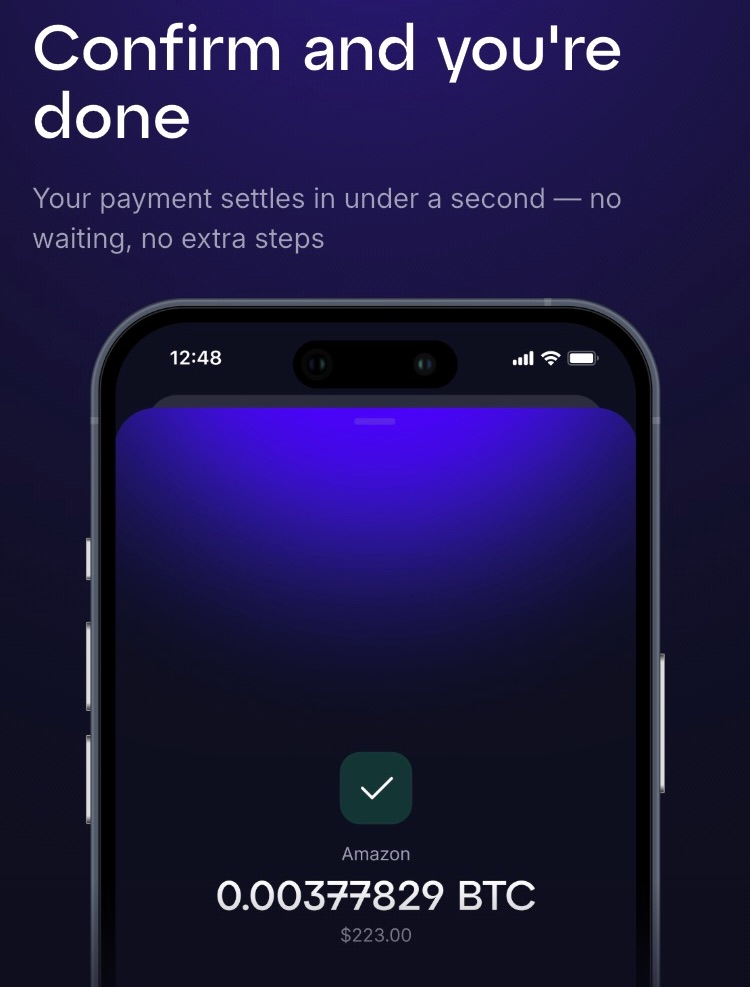
Step 3: Confirm, and you’re done. Once you confirm, the payment is approved instantly. The merchant sees confirmation immediately, with Bitcoin settlement happening in the background.
GoBTC Pay fees
For users, GoBTC Pay is free: no transaction fees, no spreads, and no hidden costs. For merchants, the acquiring fee is 0.2%. On a $100 sale, the merchant keeps $99.80.
The 0.2% merchant fee is distributed entirely back into the ecosystem. GoMining keeps none of it on third-party transactions: half goes to the miners in the GoBTC pool who confirm the transaction, and half goes to the wallet provider that initiated the payment. This revenue share is designed to incentivise wallets to integrate the protocol and grow the network.
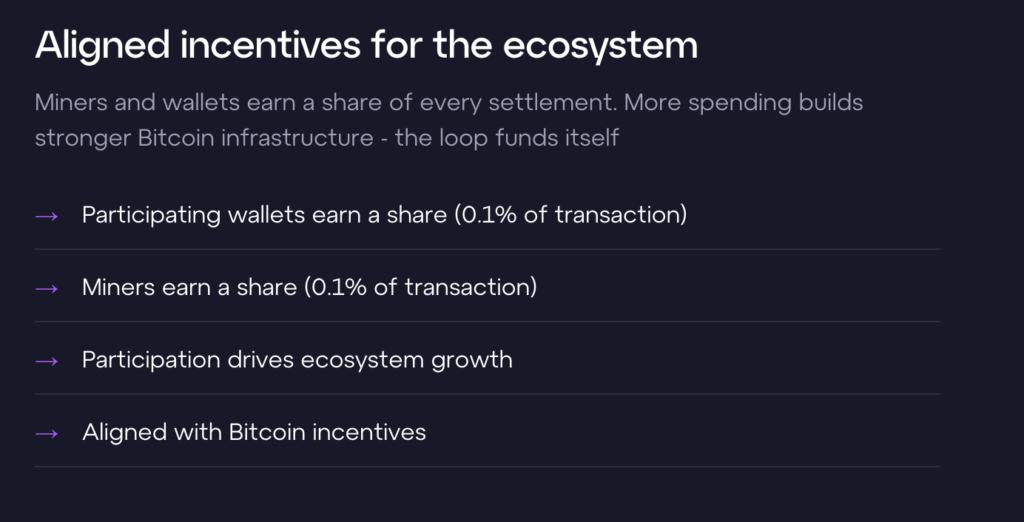
The fee structure across all parties:
- Users: zero fees per transaction;
- Merchants: 0.2% acquiring fee, settled in Bitcoin;
- Miners in the GoBTC pool: 0.1% of each transaction;
- Wallet providers that initiated the payment: 0.1% of each transaction.
GoMining covers Bitcoin network settlement fees and recovers these costs through the merchant fee rather than passing them to users. Settlement costs are further reduced through batching, where multiple user settlements are aggregated under a single Child-Pays-For-Parent (CPFP) transaction, lowering the effective on-chain cost per payment.
Is GoBTC Pay safe?
GoBTC Pay’s security architecture is built around three core principles: real Bitcoin custody on Layer 1, a non-custodial wallet model, and a conditional recovery exit path. Key details from the white paper:
- 2-of-3 multisig: User funds are held in a standard Bitcoin 2-of-3 multisignature address on the Bitcoin main chain. One key is held by the user, one by GoMining, and one offline by an independent recovery custody provider. Any transaction requires two of the three keys. GoMining alone cannot move user funds;
- Pre-authorized transactions: Every instant payment is a real Bitcoin transaction. The user signs a cumulative pre-authorization — a Partially Signed Bitcoin Transaction (PSBT) — representing the total amount authorized for settlement. GoMining cannot settle more than the latest user-signed cumulative amount;
- Recovery and exit: If GoMining becomes unavailable or refuses to co-sign, users can trigger a Conditional Recovery process. The recovery key is released either when GoMining provides on-chain proof of settlement, or when a time-based safety delay elapses, ensuring GoMining cannot permanently block user access to funds;
- Trust considerations: The recovery delay is enforced by the custodian’s policy rather than an on-chain timelock. Between batch settlement and merchant payout, settled amounts are held under GoMining custody and merchants hold unsecured credit against GoMining for that period. A future Taproot migration could shift the recovery delay to a Bitcoin consensus-enforced timelock.
GoBTC Pay vs Lightning Network
The Lightning Network is the most widely known solution for fast Bitcoin payments, and the most common point of comparison for GoBTC Pay. Both aim to make Bitcoin practical for everyday purchases, but they take different approaches.
Lightning uses off-chain payment channels, with only channel opening and closing states recorded on the Bitcoin blockchain. Running a self-hosted node is non-custodial but requires managing channels, liquidity, and routing. Custodial Lightning wallets are simpler but place the user’s full balance under the provider’s control.
GoBTC Pay settles every transaction on Bitcoin’s base layer with no channels, no liquidity management, and no routing. The tradeoff is that Lightning has no per-payment on-chain fee, only channel open and close fees, while GoBTC Pay absorbs settlement costs through batching and recovers them via the merchant fee. Lightning also has broader merchant acceptance at this stage.
| GoBTC Pay | Lightning Network | |
| Settlement | Bitcoin L1, batched | Off-chain channels, L1 on close |
| Custody | 2-of-3 multisig, non-custodial | Self-custodial (node) or custodial (wallet) |
| User complexity | Simple, no channels | Complex (node) or simple (custodial) |
| User fees | Zero | Usually low, varies |
| Merchant acceptance | Early stage | Broader |
Who is GoBTC Pay for?
GoBTC Pay is built for three audiences:
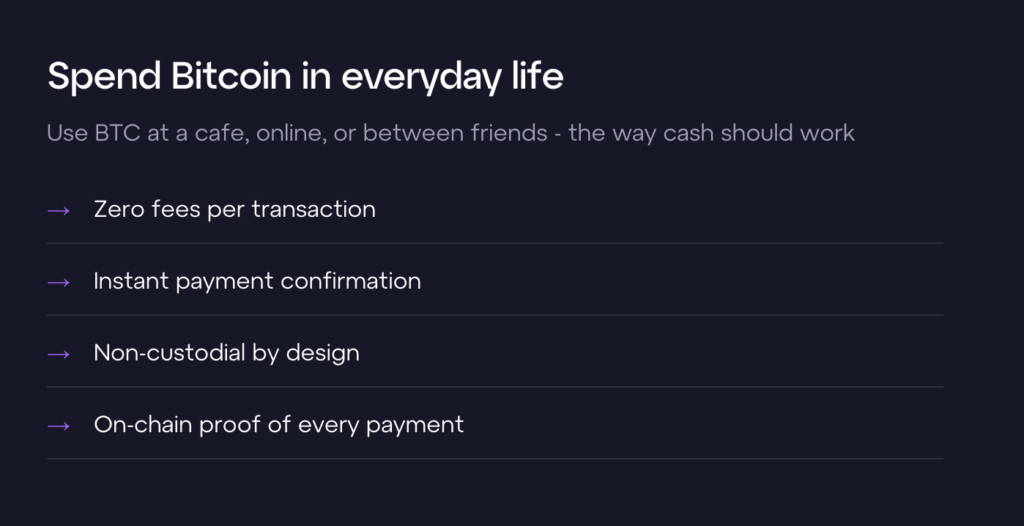
- Bitcoin holders who want to spend BTC: Users who hold Bitcoin and want to use it for everyday purchases without converting to fiat or paying transaction fees. Payments are made by scanning a QR code at a GoBTC-enabled merchant, with instant confirmation and no waiting for block confirmation at the point of sale;
- Merchants looking to accept Bitcoin: Businesses that want to accept Bitcoin payments with lower fees than card networks, instant confirmation, and no chargebacks. The 0.2% acquiring fee is substantially below standard card processing rates, and settlement is handled automatically by GoMining in the background. A POS app, merchant dashboard, and SDK are currently in development;
- Wallet and platform providers: Any Bitcoin-capable wallet can integrate GoBTC Pay through the SDK and offer instant Bitcoin payment functionality to their own users, earning 0.1% on every transaction they initiate.
Who it is not for:
- Users who require full single-key self-custody, since the BTC Pay wallet operates on a 2-of-3 multisig model with GoMining as a co-signer;
- Users or merchants who need instant on-chain Bitcoin settlement, since final confirmation happens in batches rather than immediately;
- Merchants in markets where no GoBTC-enabled merchants are active yet, since the network is in early development.
Disclaimer: The content on this site should not be considered investment advice. Investing is speculative. When investing, your capital is at risk.
FAQs
What is GoBTC Pay?
GoBTC Pay is a Bitcoin payment protocol that lets users spend BTC at point-of-sale merchants instantly, with no fees and no fiat conversion. It is built by GoMining and operates on Bitcoin’s base layer.
Is GoBTC Pay the same as Lightning?
No. Lightning uses off-chain payment channels and only records channel opening and closing states on the Bitcoin blockchain. GoBTC Pay settles every transaction on Bitcoin’s base layer, with no channels to open or manage.
How much does GoBTC Pay cost?
Nothing for users. Merchants pay a 0.2% acquiring fee, which is split equally between the miners who confirm the transaction and the wallet provider that initiated the payment. GoMining keeps none of the fee on third-party transactions.