

UXUY is an onchain trading platform that describes itself as stablecoin-native, offering spot crypto, perpetual contracts, equity-linked assets, and real-world assets (RWA) from a single account. This review covers how the platform works, its gasless rules and supported networks, how its perpetuals handle liquidation, what it costs, and whether it is safe to use.
What is UXUY?
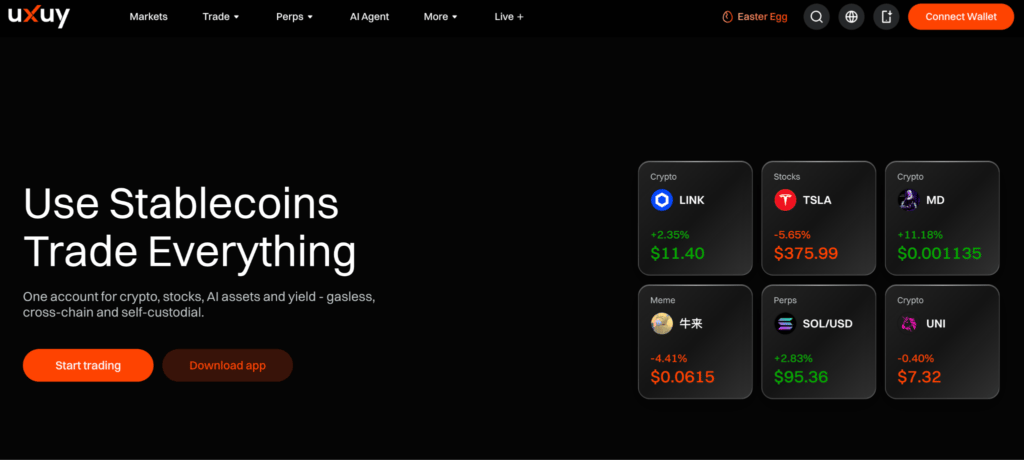
UXUY is an onchain trading platform that calls itself stablecoin-native. Users trade with stablecoins from one account and one interface. The platform covers crypto assets, perpetual contracts, equity-linked assets, and real-world assets.
According to UXUY, the platform is incubated by Binance Labs and backed by YZi Labs. Its stated vision is “Buy Everything with U”.
Advertisement
UXUY lists four features that set it apart:
- Stablecoin-native: stablecoins are the unit of account and settlement, so users do not need native tokens for each chain;
- One account, multiple markets: all products sit in the same account;
- Automatic cross-chain routing: the system finds a path for each trade, so users do not pick chains or bridge assets by hand;
- Onchain verifiable: settlement records are published onchain and can be checked on block explorers.
According to UXUY, traders can use the platform through its app or on the web. The availability of products and markets may vary by region and platform version.
UXUY markets and products
UXUY gives access to its markets through a single interface. Everything runs from the same account.
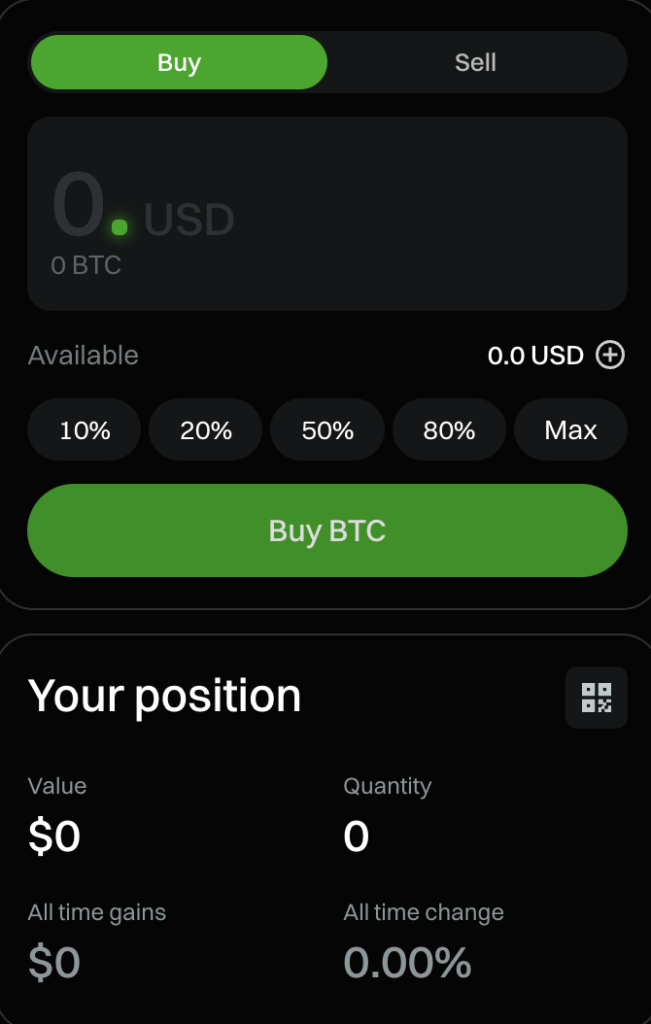
- Spot trading: UXUY offers one-click crypto buying and selling. Each market has a price chart, a Buy and Sell panel, and a position tracker. Users trade with their stablecoin balance, and UXUY may route trades across supported networks and liquidity sources. Before confirming, users should check the estimated price, slippage, fees, the minimum amount received, and the route;
- Stocks trading: the menu item reads “Trade US & HK Stocks in USD”. UXUY’s Trading page describes what it offers as supported equity-linked assets. UXUY does not say that users own the underlying shares. The page also mentions real-world assets (RWA), which the Trade menu does not list separately. Trading hours, liquidity, pricing, settlement, and regional availability differ by product. When the primary market is closed, liquidity may be lower and spreads wider;
- Swap: token swaps across chains. Users choose the asset they pay and the asset they receive, and the page shows the rate;
- Bridge: a cross-chain stablecoin bridge. The page is called USD Switch, and users select a target stablecoin;
- Perpetual contracts: users trade with margin and leverage. These contracts have no fixed expiry date, but holding a position may carry funding costs. A position can be liquidated if margin runs low;
- Copy trading: users can follow eligible traders and copy their selected activity, using copy settings they choose. Availability depends on the product version shown in the app.
How UXUY works
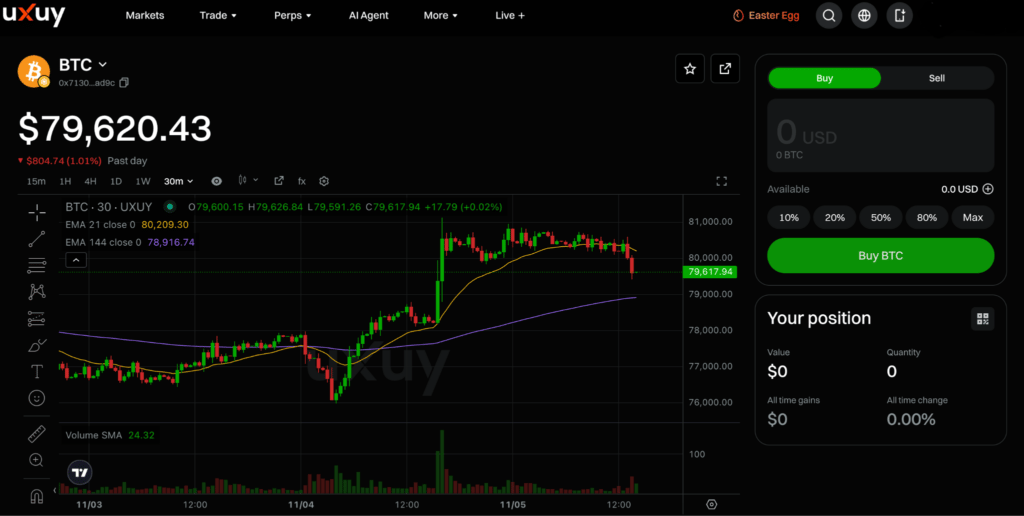
UXUY says it handles the technical steps of a trade in the background. Users pick a market and an amount. The platform deals with wallets, networks, and routing.
- Smart contract accounts: UXUY is built on smart contract account infrastructure. This simplifies wallet creation and onchain interaction, and trade records stay verifiable on the blockchain;
- Cross-chain routing: UXUY checks a user’s balances and the paths available across supported networks. After a user submits a trade, the system weighs liquidity, price, slippage, network costs, and routing status. It then executes the trade. Users do not pick chains or bridge assets by hand;
- Onchain settlement: trades are executed or settled through supported blockchain networks or protocols. Where applicable, users can check the matching transaction record on the relevant block explorer.
Advertisement
UXUY also says it handles gas in the background for eligible transactions. The rules for that are covered in the next section.
Gasless trading
UXUY says it can cover network gas fees for eligible transactions, so users may not need to hold the native token of every network. Eligibility depends on the transaction type, the networks involved, the amount, and a daily limit. Final fees are shown before a user confirms.
The main rules:
- Native token first: when a transaction deducts from a user’s address, the user’s own native token pays gas first. Gasless is only checked if that balance is too low;
- Strictest network applies: if a transaction involves several networks, the network with the tightest rules decides. If any of them does not support gasless, the order is not eligible;
- TRON is excluded: gasless does not work on TRON;
- No equities: gasless does not apply to US or Hong Kong stock trading.
UXUY sets a daily limit and a minimum amount for each type of transaction:
| Transaction type | Daily limit | Minimum amount |
| Spot trading | Up to 20 | 10 Tether (USDT) on BNB Chain, Base, X Layer, Polygon and Arbitrum. On Ethereum, 50 USDT and a gas price below 10 Gwei |
| Transfers | Up to 5 | Same amounts as spot trading. The token must also support gasless, as not all tokens do |
| Decentralized application (DApp) transactions | Up to 5 | The network must support gasless. On Ethereum, the gas price must be below 10 Gwei |
UXUY’s rules are unclear on Solana. It appears in the list of networks with a 10 USDT threshold, but another line says Solana users pay the network fee directly.
Moving funds inside the platform also has a fee rule. Transfers from Spot to Perpetuals are fully gasless. Transfers from Perpetuals to Spot cost 0.1 USDT.
Advertisement
UXUY adds that eligibility rules, minimum amounts, and supported networks may vary.
Supported networks
UXUY’s documentation lists eight networks for deposits and withdrawals: Ethereum, BNB Smart Chain, Base, Arbitrum One, X Layer, Solana, Polygon and TRON. The web Receive screen shows eleven deposit tabs, adding Robinhood Chain, Arc, and Akashic.
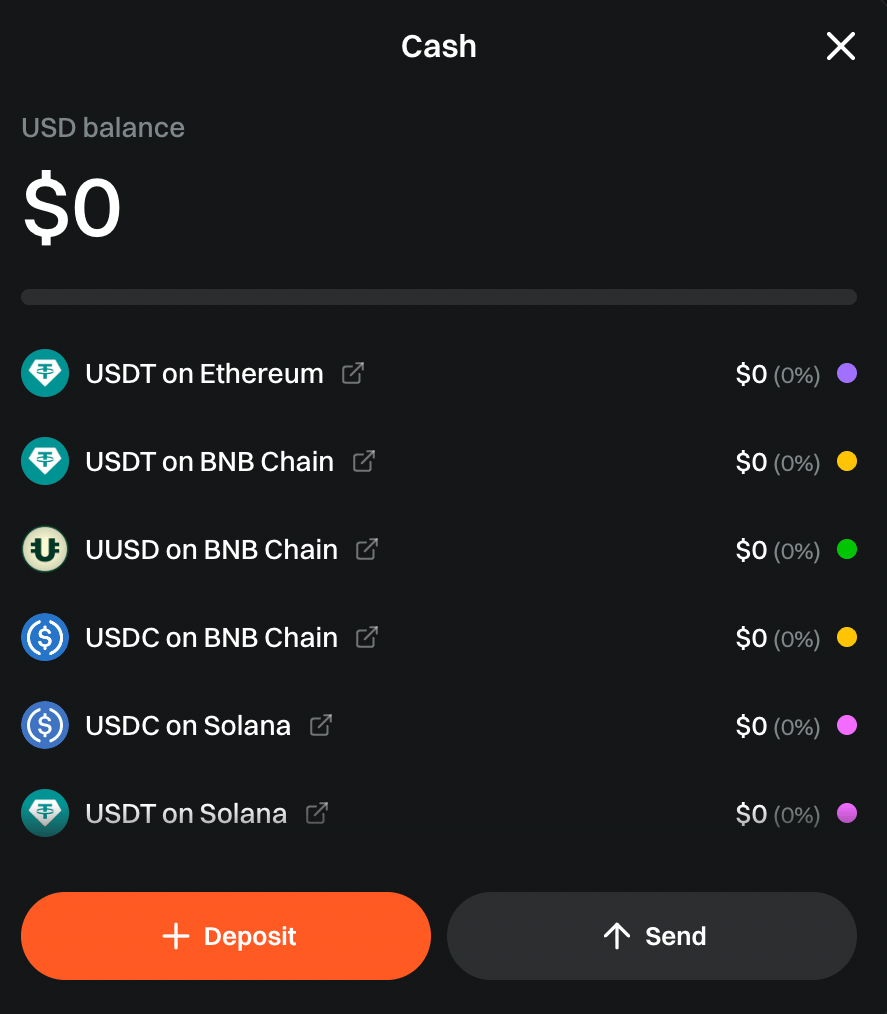
UXUY counts supported stablecoins as “Cash”, which it shows as one USD balance. Other tokens go to holdings. The Cash screen lists the stablecoins that count toward that balance, with the amount held in each. It lists 16 balances across the eleven networks:
| Network | Stablecoins listed as Cash |
| Ethereum | USDT |
| BNB Chain | USDT, USD Coin (USDC), UUSD |
| Solana | USDC, USDT |
| Base | USDC |
| Arc | USDC |
| Robinhood Chain | USDG, UUSD |
| Tron | USDT |
| Polygon | USDC, USDT0 |
| Arbitrum | USDC |
| X Layer | USDT0 |
| Akashic | UUSD |
Gasless does not work on TRON. UXUY’s gasless rules do not mention Robinhood Chain, Arc, or Akashic. UXUY says network support may change and that the information in the app takes priority.
Users should match the asset and network exactly when depositing. UXUY warns that an unsupported network may delay crediting. It may also leave assets that cannot be recovered. Withdrawal availability, processing times, and fees vary by asset and network.
How to get started with UXUY
UXUY says users should download the app only from its official website or from verified app store pages. It warns against installation links shared through unofficial channels. The official download page is uxuy.com/download. UXUY can also be used on the web at uxuy.com.
Step 1: Create an account
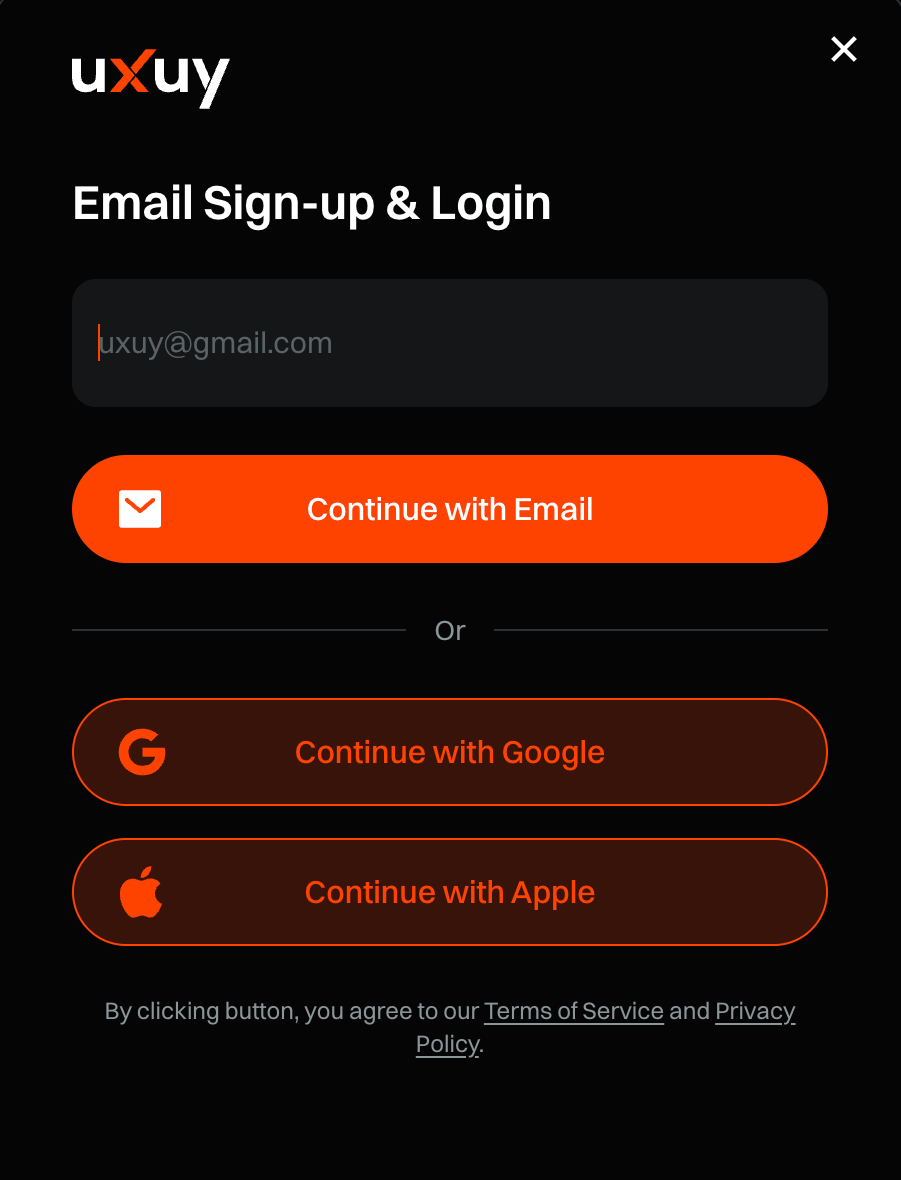
Users can sign in with an Apple ID, a Google account, or an email verification code. Then they follow the on-screen instructions. After sign-up, UXUY asks users to set a platform login password, which it says is used for login and withdrawals. Users can choose “Maybe later”.
Step 2: Deposit assets
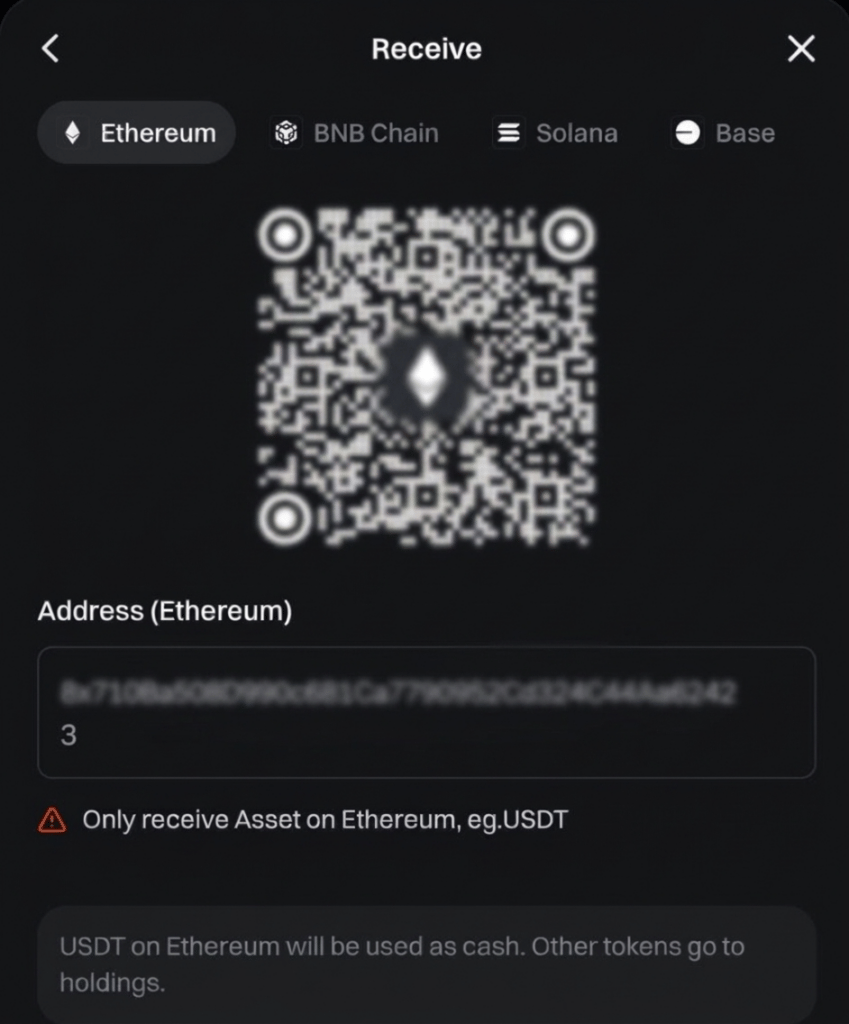
On the web version, open the Portfolio page, select the USD balance, choose a stablecoin such as USDT, and select Deposit. A Receive screen opens with a tab for each network, a QR code, and a deposit address. Copy the address or scan the code, then send the assets from an external wallet or trading platform.
UXUY treats supported stablecoin deposits as cash. The Cash screen lists the stablecoins that count toward the USD balance, such as USDT on Ethereum and USDC on Solana, with the amount held in each.
The asset and network must match exactly on both sides. UXUY warns that an unsupported network may delay crediting or leave assets that cannot be recovered.
Step 3: Place a first trade
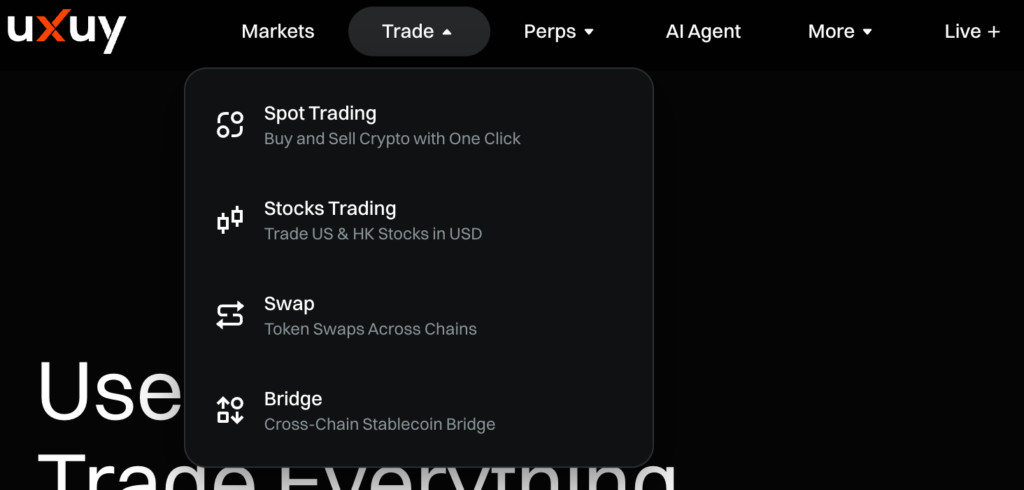
Open the Trade menu and choose a market, such as Spot Trading. Enter the amount. Before confirming, check the estimated price, fees, slippage, and route. After the trade, the result appears in the order history or in onchain transaction records.
Step 4: Withdraw
Open the Assets or Funds page and select Withdraw. Choose the asset and the network, then enter the receiving address and amount. Check the network, fees, and address before submitting. Availability, processing times, and fees vary by asset and network.
UXUY advises users to understand margin, liquidation, and funding rates before using leveraged products.
On security, UXUY tells users to check that they are on an official domain or the official app. They should never share verification codes, private keys, or recovery phrases. UXUY says its support will never ask users to send assets to an unfamiliar address.
How UXUY perpetual contracts work
Perpetual contracts let users open long or short positions on supported markets. They have no fixed expiry date. A long position can gain when the price rises, and a short position can gain when it falls. Leverage raises exposure for the same margin. According to UXUY, it raises risk to the same degree.
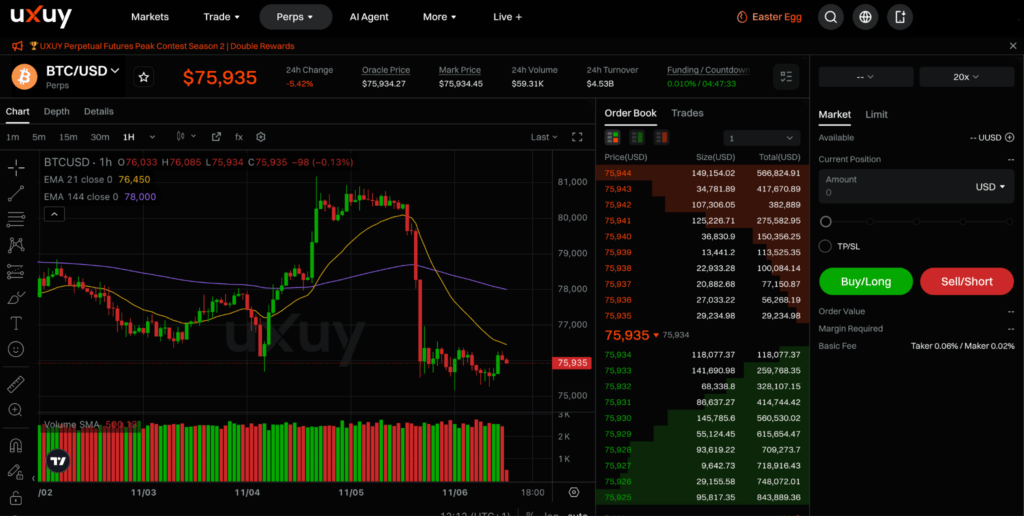
The main mechanics:
- Margin and fees: the margin needed depends on the order size, the price and the leverage. For a limit order, UXUY uses the limit price. For a market order, it uses the mark price at submission. Final margin and fees follow the actual fills and the applicable maker or taker rate;
- Risk tiers: UXUY sorts positions into tiers by size. Larger positions face higher margin requirements and lower maximum leverage. A position moves between tiers as it grows or shrinks. The exact tiers appear in the trading interface;
- Liquidation: each position has a maintenance margin, the minimum needed to keep it open. UXUY describes liquidation under isolated margin mode. Each position has its own margin, so only the affected position is liquidated, and other isolated positions are generally not affected. When margin falls below the requirement, the system closes the position in the market. The final price depends on liquidity at that moment. UXUY then settles the profit or loss, deducts fees, and updates the account;
- Insurance fund: if a liquidated position cannot be closed at a price that covers its loss, the insurance fund absorbs the loss first. UXUY says it is funded by surpluses from liquidations filled at better prices, reserves allocated by the platform and other permitted funds. Funds may be accounted for separately by market;
- Auto-deleveraging (ADL): this is the final layer of risk control. It applies when liquidations cannot be filled, losses occur, and the insurance fund cannot cover them. The platform may then reduce some profitable positions, ranked by profit level, effective leverage, and position size. A position can be partly or fully closed. Results appear in trade records or notifications;
- Mark price and index price: the mark price is not the last traded price. UXUY uses it to calculate unrealized profit and loss and to trigger liquidation. It does not affect order matching, which uses prices available in the market. The index price is a weighted average of prices from reference trading platforms. A failed source may be excluded;
- Funding rate: longs and shorts pay each other at set intervals, which helps keep the contract price close to the underlying market. When the rate is positive, longs pay shorts. When it is negative, shorts pay longs. Only positions open at settlement pay or receive funding. UXUY says funding generally does not count as platform fee revenue.
UXUY says the liquidation price in the app may differ from simple formulas. Fees, funding costs, tier changes, and rounding all affect it. If the documentation and the trading interface differ, UXUY says the interface applies.
UXUY’s terms describe perpetual trading as access to third-party protocols that UXUY does not operate, and say those protocols set fees and funding rates. UXUY’s other pages describe the insurance fund, vaults and settlement as its own. UXUY does not explain the difference.
Is UXUY safe?
UXUY lists several security measures. Its terms of service, effective 1 October 2025, also describe its regulatory status.
- Audits: UXUY says independent security firms audit its core contracts and that the reports are public. The page lists three reports, all from SlowMist: UXUY Swap, UXUY Smart Pool and UXUY Smart Wallet. It does not list a report for the perpetual contracts system;
- Custody: UXUY’s homepage calls the platform self-custodial, and its terms call it a non-custodial interface. Its security page says platform funds are held separately in a hot vault and a cold vault;
- Published addresses: UXUY publishes the onchain addresses of the vaults, the settlement contract, and the staking pool for its perpetuals system, so users can check transactions and fund flows. It advises relying only on addresses in its official docs;
- Insurance fund: according to UXUY’s documentation, the fund absorbs losses from liquidations in extreme markets;
- Asset recovery: UXUY offers a tool for assets sent to a UXUY smart contract account through a wrong or unsupported deposit path. It covers seven chains: opBNB, Arbitrum One, Optimism, BNB Smart Chain, Base, Ethereum, and X Layer. For other chains, users contact customer support. The steps involve importing the account’s recovery phrase into MetaMask and holding a small amount of the chain’s native token for gas;
- Scam warnings: UXUY tells users to download the app only from its official website or verified app stores and to check that they are on an official domain. They should never share verification codes, private keys, or recovery phrases. UXUY says it will never ask users by direct message to send funds to unknown addresses;
- Regulatory status: UXUY’s terms say it is mainly a developer of open-source software and does not operate a virtual currency or derivatives exchange. They say UXUY is not registered or licensed by the Commodity Futures Trading Commission (CFTC), the Securities and Exchange Commission (SEC) and the Financial Crimes Enforcement Network (FinCEN), or any financial regulator, and that no regulator has reviewed its software or services. Users are responsible for following the laws that apply to them.
Leveraged positions carry their own risks. A perpetual position can be liquidated, and auto-deleveraging can close profitable positions if the insurance fund runs short.
What does UXUY cost?
UXUY says it shows the final fees on screen before a user confirms a transaction. Its documentation does not list a full fee schedule. The costs it does state or show are:
- Perpetual trading fees: the BTC/USD perpetuals page lists a basic fee of 0.06% for takers and 0.02% for makers, as seen on 6 November 2026. UXUY says the actual fee follows the filled quantity, the execution price, and the applicable maker or taker rate;
- Spot trading: UXUY tells users to check the estimated price, trading fees, network fees, slippage, and minimum amount received before confirming. It does not publish a fee rate for spot trades;
- Network fees: UXUY says it covers gas for eligible transactions, within daily limits and minimum amounts. On EVM networks, UXUY prompts users to reserve native tokens or stablecoins, and on Solana users pay the fee directly. Withdrawal fees vary by asset and network;
- Moving funds between accounts: transfers from Spot to Perpetuals are fully gasless. Transfers from Perpetuals to Spot cost 0.1 USDT;
- Funding costs: holding a perpetual position may incur funding payments. These go between long and short traders, and UXUY says they generally do not count as platform fee revenue;
- Liquidation fee: UXUY’s liquidation calculations include a fee on the liquidated quantity. The rate is not published.
UXUY’s terms of service add that it does not charge trading fees on third-party derivatives protocols, and that those protocols set their own fees, funding rates and penalties.
UXUY support and community
UXUY lists its official channels on its Contact page and warns users to get information and installation files only from them. It says its support will never ask users by direct message to send funds to unfamiliar addresses, or to share private keys, recovery phrases or verification codes.
UXUY is active on the following channels:
- Official website;
- App download page;
- X (formerly Twitter);
- Telegram community;
- Blog;
- GitHub;
- LinkedIn.
The web interface also has a support chat button. In our check, an AI assistant answered it. For legal notices, UXUY’s terms of service list [email protected].
Conclusion
UXUY’s main strength is breadth. One account covers crypto, equity-linked assets, perpetual contracts, token swaps and a stablecoin bridge, with copy trading on top. UXUY says the stablecoin balance and the gasless option for eligible transactions remove the need to juggle several wallets and networks.
That simplicity has limits. Gasless has daily caps and minimum amounts. UXUY’s documentation lists no full fee schedule or maximum leverage. Some features also depend on region and platform version.
UXUY looks best suited to traders who want several markets in one place and are comfortable holding stablecoins. Anyone considering perpetuals should read the liquidation rules first. Before depositing, users should check fees, supported networks, and availability in the app.
Disclaimer: The content on this site should not be considered investment advice. Investing is speculative. When investing, your capital is at risk.
FAQs
What is UXUY?
UXUY is an onchain trading platform that describes itself as stablecoin-native. From one account, users can trade crypto, equity-linked assets, perpetual contracts, and swaps and move stablecoins between networks. It works on the web and in the app.
What can I trade on UXUY?
The Trade menu offers spot crypto, US and Hong Kong stocks in USD, swaps across chains, and a cross-chain stablecoin bridge. UXUY also offers perpetual contracts and copy trading. UXUY describes the stocks as equity-linked assets and says it also offers real-world assets.
What is gasless on UXUY?
UXUY says it can cover network gas fees on eligible transactions. Eligibility depends on the transaction type, the network, the amount, and a daily limit. Spot trades are limited to 20 a day and require at least 10 USDT on most supported networks, or 50 USDT on Ethereum. TRON and US and Hong Kong equity trading are excluded.
Is UXUY safe?
UXUY lists three SlowMist audit reports for its swap, smart pool, and smart wallet. It also publishes the addresses of its perpetual vaults. Its terms say it is not registered or licensed by financial regulators, and perpetual positions can be liquidated. Users should read the terms and check the details in the app before depositing.