
Technical analyst TradingShot has projected a possible $165 drop in Nvidia (NASDAQ: NVDA) stock, with the decline expected by late August 2026.
The Nvidia stock crash prediction, shared in a TradingView post on June 30, is based on a weekly ascending triangle pattern currently in its bearish leg, the same setup that preceded a similar move in February 2025.
Notably, Nvidia stock is rebounding this week after nearly touching its one-week 50-period moving average for the first time since the week of March 30, 2026.
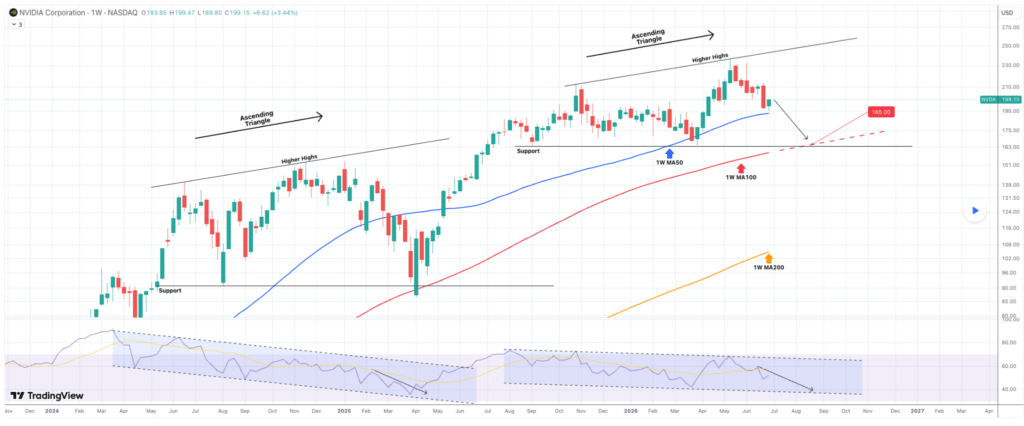
TradingShot stated that this bounce mirrors the one from February 2025, which also occurred during the bearish leg of the same ascending triangle structure. In this line, Nvidia ended the last trading session up more than 2% at $200.
Significance of NVDA stock at $165
According to TradingShot, both fractals show identical weekly RSI sequences. Based on that repeating pattern, the next target before any sustainable rebound can be discussed is the one-week 100-period moving average, which aligns with support at $165.
That level previously acted as a floor earlier in the ascending triangle, making it a technical target rather than an arbitrary figure.
At the same time, Nvidia’s weekly chart has formed a broader ascending triangle since 2024, marked by higher highs against a flatter support line.
The pattern has repeated twice: through the 2024-to-early-2025 uptrend and again during the 2025-to-2026 rally that pushed NVDA above $230 in May 2026 before pulling back.
In both cases, the price tested the rising trendline, pulled back, bounced off the one-week MA50, and then continued toward the one-week MA100 and support. TradingShot’s analysis places Nvidia in the early stage of that same sequence now.
A weekly close back above the $230 highs would weaken the bearish case and favor continuation of the broader uptrend.
A break below $165 support, on the other hand, would open the door to a deeper move toward the one-week 200-period moving average, a level not tested since the triangle began forming.
Nvidia’s strong fundamentals
Interestingly, the pullback stands in contrast to Nvidia’s underlying financial performance. Latest-quarter revenue grew 85% year over year, with adjusted earnings rising 139%, while the company posted an adjusted net margin of 55.7%.
For full fiscal 2026, revenue reached $215.9 billion, up 65% from the prior year, including fourth-quarter revenue of $68.1 billion, a 73% year-over-year increase.
CEO Jensen Huang pointed to exponential growth in computing demand tied to agentic AI adoption, with the Blackwell platform reducing the cost per token by an order of magnitude compared with prior generations.
Nvidia is also projecting $3 trillion to $4 trillion in industry-wide data center capital expenditure by 2030.