
On the back of Alphabet’s (NASDAQ: GOOGL) ‘I/O 2026’ presentation, multiple Wall Street analysts issued generally bullish price targets and rating revisions for Google stock, signalling rising confidence in the technology giant’s artificial intelligence (AI) strategy.
To begin with, Bank of America’s (NYSE: BAC) Justin Post appears especially impressed with the further development of the wider AI infrastructure, growing usage of ‘AI mode’ in search, the novel audio-first smart glasses, and a general position of ‘leadership in shaping consumer AI experiences.’
Between the positive developments, the Wall Street analyst decided to reissue his previous ‘Buy’ rating and the bullish $430 12-month price target for a 10.98% expected rally from the press time price of $387.45.
Simultaneously, Wells Fargo (NYSE: WFC) experts noted the apparent improvements in the ability to monetize compute, which, along with the overall cloud division strength, justifies the Google stock ‘Buy’ rating and the price forecast increase from $427 to $435.
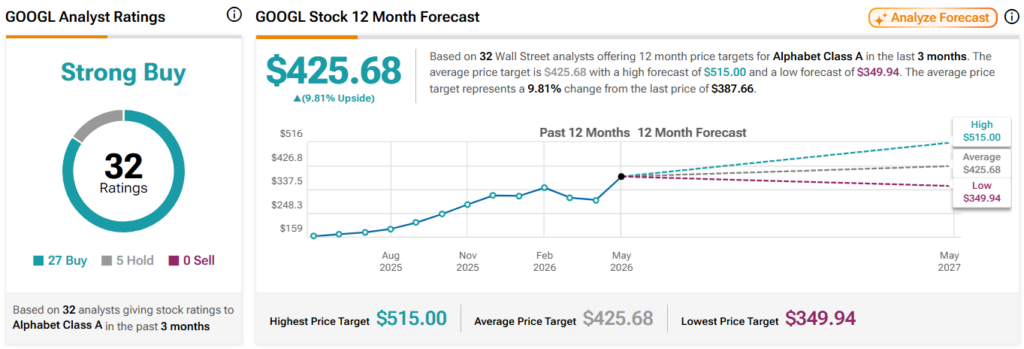
Wall Street sets Google stock price target for the next 12 months
Zooming out, the most recent revisions are consistent with the views Wall Street has been maintaining through the last three months.
Specifically, Google stock is overall considered a ‘Strong Buy’ with no ‘Sell’ recommendations, five ‘Hold’ ratings, and as many as twenty-seven ‘Buy’ rankings, per the data Finbold retrieved from TipRanks on May 20.
Similarly, the average 12-month price target stands at a bullish $425.68 for a total 9.81% anticipated rally by the first half (H1) of 2027.
Google stock soars 24% in 2026 despite growing AI concerns
Looking at Alphabet’s stock market performance, it is impossible to dispute that the equity enjoyed significant success considering it rallied 23.78% year-to-date (YTD) to its May 20, press time price of $387.45.
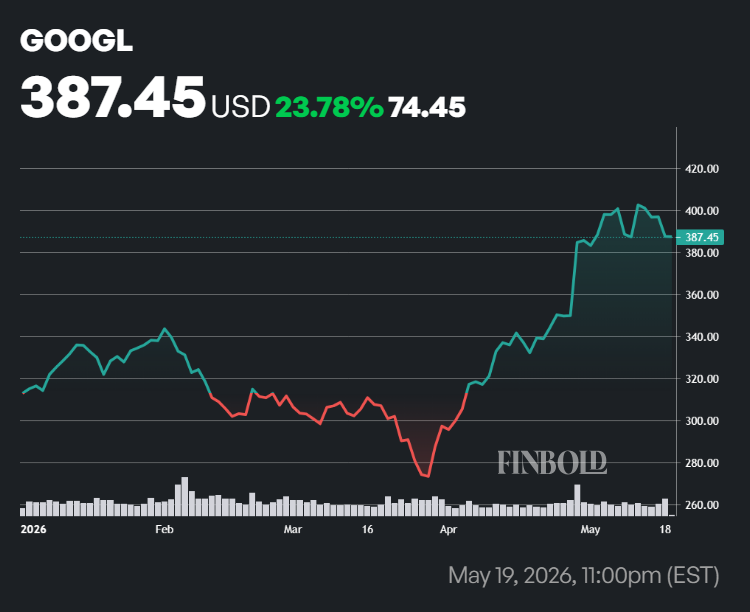
More recent trading, however, demonstrates the growing strain on the AI boom narrative, and while every ‘Magnificent 7’ stock other than Apple (NASDAQ: AAPL) suffered a drop in the May 19 session, GOOGL was the biggest loser with nearly a $100 billion valuation drop.
The difference between the ‘I/O 2026’ presentation’s ability to impress analysts and investors – Google stock remained effectively flat through the extended session leading into May 20 – also demonstrates the extent to which apparently impressive adoption figures are muddied by forceful integration of AI into most consumer software, and internal usage mandates across big tech.
Featured image via Shutterstock