
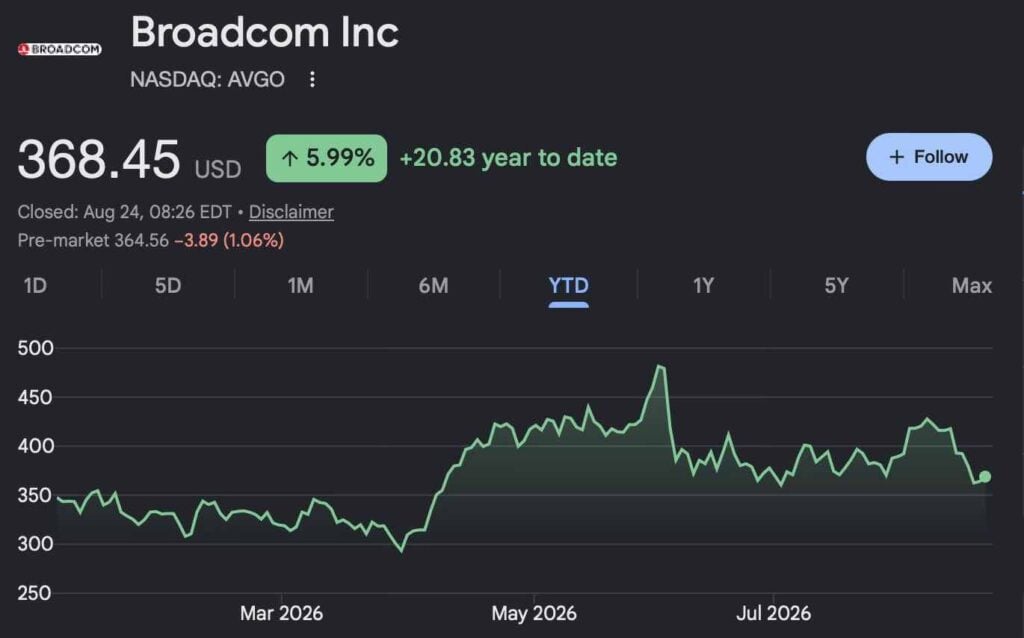
Broadcom (NASDAQ: AVGO) stock lost around 1% in pre-market trading on Monday, August 24, as risk appetite weakened across large-cap technology stocks due to index futures moving lower.
Zooming out, the past couple of months have been quite uneventful for Broadcom, following a generally favorable April, when most of the stock’s gains this year were generated.
Nonetheless, the tech company has gained nearly 6% so far in 2026. Specifically, the stock is currently trading at around $368, up from $347 on the first session this year.
In other words, a $1,000 investment at $347 per share, which would have purchased approximately 2.88 shares, is worth about $1,061 at the current levels, representing a gain of roughly $61.
Will AVGO stock rally in 2026?
While the Broadcom price action has been somewhat muted, some potential catalysts are beginning to emerge. For example, J.P. Morgan said on August 20 that investors may be underestimating the company’s long track record of execution at Alphabet (NASDAQ: GOOGL) and sees the stock as an attractive buying opportunity at current levels.
Under their current agreement, the bank says, Broadcom is expected to remain involved with Google’s TPU v8 through v11 generations, with revenue commitments increasing over time. Thus, J.P. Morgan estimates that the company could generate more than $56 billion in AI-related revenue in fiscal 2026.
What’s more, Broadcom is now reportedly in talks to raise as much as $70 billion to $80 billion in debt to finance chips and computing infrastructure for artificial intelligence (AI) companies, including Anthropic.
In June, Broadcom had already announced an AI platform designed to support up to 20 gigawatts of computing capacity for customers including Anthropic and OpenAI. The latest discussions could thus significantly expand that funding.
While the strategy carries significant financial risks, the opportunity remains substantial, as strong demand from hyperscalers and AI developers seeking alternatives to Nvidia (NASDAQ: NVDA) GPUs has positioned the company as a major beneficiary of AI-related capital spending.
Featured image via Shutterstock