
SpaceX (NASDAQ: SPCX) has experienced a volatile first few months as a publicly traded company, with its shares surrendering a significant portion of their early gains.
The company’s June 2026 stock market debut attracted considerable investor interest, but its subsequent performance has been less impressive than its initial rally suggested.
SpaceX priced its IPO at $135 per share on June 11, 2026, before beginning trading on the Nasdaq the following day. At that offering price, a $1,000 investment would have purchased approximately 7.41 shares.
Advertisement
With SpaceX closing at $139 on November 13, the investment would now be worth about $1,030, a 3.04% gain, excluding brokerage fees, taxes, and other costs.
Despite remaining above its $135 IPO price, SpaceX stock has experienced considerable volatility since its public debut.
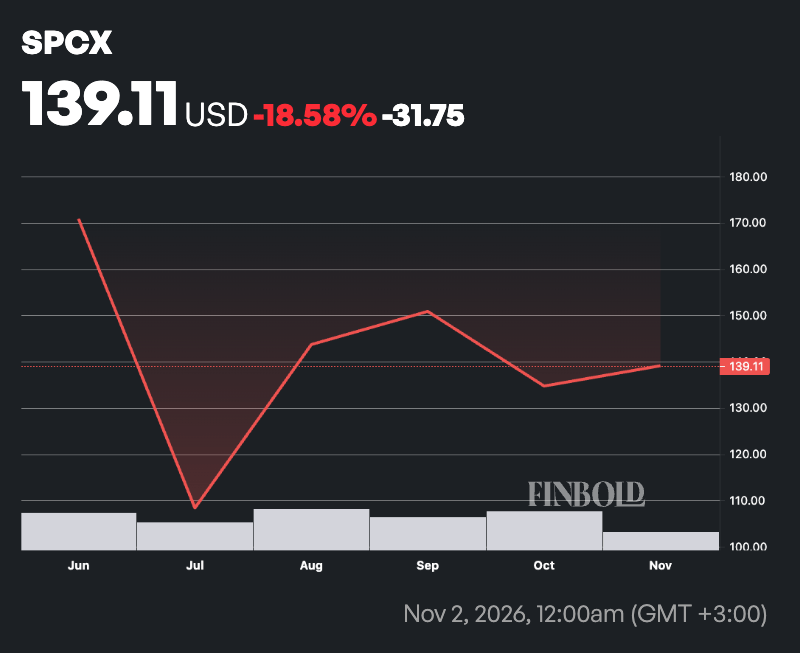
Shares opened at $150 on June 12, 2026, and reached an intraday high of $176.52 before closing at $160.95, up 19.22% from the offering price.
The rally continued, pushing shares to an intraday record of $225.64 on June 16, before much of those gains were erased. At $139.11, the stock is now 38.3% below that peak.
The difference between the IPO price and the first-day closing price is significant. While IPO investors remain in profit, someone who invested $1,000 at the first-day closing price of $160.95 would now have approximately $864, a 13.57% loss.
What is driving SpaceX stock performance?
SpaceX’s financial performance has provided some support for its valuation, although its substantial investment requirements remain an important consideration.
Advertisement
In its third-quarter 2026 financial results, the company reported revenue growth of 69.5% year over year. The increase was supported by expanding Starlink subscriptions and growth in its enterprise and government businesses.
Starlink consumer subscribers increased 88.9% year over year, although average revenue per user declined 16.9% as the company expanded internationally and introduced lower-priced service plans.
Meanwhile, SpaceX reported $4.40 billion in net income for the third quarter, compared with a $1.05 billion loss in the corresponding period of 2025.
However, the company’s expansion has also required substantial investment. SpaceX reported approximately $48.07 billion in capital expenditures during the first nine months of 2026, reflecting spending on data centers, infrastructure, and space launch facilities.
The scale of that spending presents a potential challenge for investors assessing how efficiently the company can convert its expansion into sustainable financial returns.
Featured image via Shutterstock