
Oobit Agent Cards are programmable virtual Visa cards that give AI agents real spending power within strict, predefined financial boundaries. This guide covers everything businesses need to know about Oobit Agent Cards, from how they work to how to get started.
What is Oobit?
Oobit is a global payments app that allows users to spend cryptocurrencies anywhere Visa is accepted. It supports in-store, online, and cross-border payments while letting users keep their funds in their own crypto wallets.
Oobit is backed by Tether (USDT) and operates through compliant issuing infrastructure across more than 100 countries. Its focus is on making crypto payments functional at scale for both individuals and businesses.
What are Oobit Agent cards?
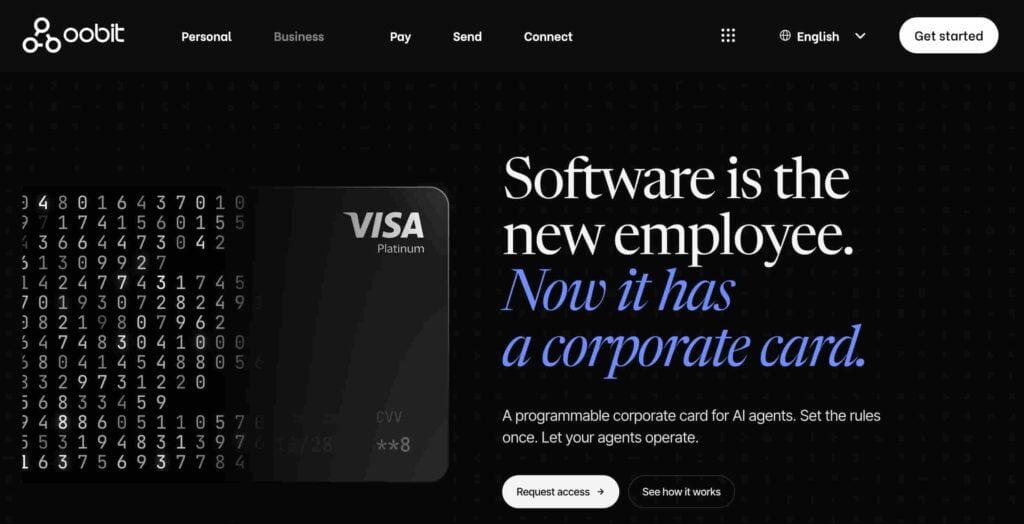
Oobit Agent Cards are virtual payment cards designed to allow AI agents to carry out real-world transactions under defined limits. The product is built for businesses that rely on autonomous or semi-autonomous agents to manage operational tasks such as subscriptions, cloud services, advertising spend, or vendor payments, without handing over unrestricted access to corporate card credentials.
Each Agent Card is issued on the Visa network and linked to a specific AI agent rather than a human user.
Cards are funded directly from a company’s stablecoin treasury, typically USDT, and operate without requiring fiat conversion. Spending rules, such as transaction limits, merchant categories, and usage scope, are set in advance and enforced at the system level, meaning agents cannot exceed or bypass them.
Availability
How do Oobit Agent Cards work?
Oobit Agent Cards are designed to fit into existing business and AI workflows, with a setup and operating model focused on control, traceability, and automation. The process is structured to ensure that AI agents can make payments independently, while businesses retain clear oversight.
The system works as follows:
- One card per AI agent: Each AI agent is issued its own dedicated virtual Visa card. This creates a clear identity for each agent, avoids shared credentials, and makes it easier to track spending at the individual-agent level;
- Funded directly with stablecoins: Cards are funded directly from a company’s treasury, without requiring fiat conversion;
- Predefined spending rules: Spending policies are configured during setup and enforced server-side. These include per-transaction spending limits, per-merchant caps, and category-level restrictions tied to the agent’s function. Once set, these rules cannot be overridden by the agent, or anyone else;
- Real-time transaction logging: Every attempted payment, whether approved or declined, is recorded instantly with a human-readable explanation. This removes ambiguity around pending charges and eliminates the need for separate reporting infrastructure;
- Fast activation: Businesses can activate an Agent Card through a guided five-step wizard, with cards going live in under three minutes once the business is KYB-verified. Agent Cards is compatible with major agent frameworks, including LangChain, AutoGen, OpenAI Assistants, Claude, CrewAI, and Mastra, as well as any custom framework with API access.
Overall, the model is designed to let AI agents act autonomously within strict financial boundaries, reducing operational friction without introducing unchecked spending risk.
How to set up Oobit Agent Cards
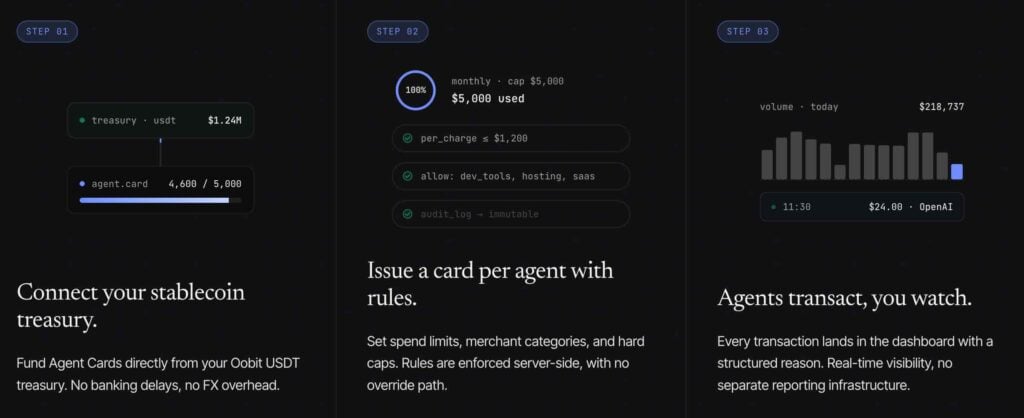
Setting up Agent Cards is designed to be quick and structured, with only a few required steps before AI agents can begin transacting under predefined rules. The setup process follows three core stages:
- Connect your stablecoin treasury: The first step is linking your treasury to the platform. Agent Cards are funded directly from this balance, with no fiat conversion, banking delays, or foreign exchange overhead. Once connected, funds can be allocated to individual agent cards as needed;
- Issue a card per agent and define rules: Each AI agent is assigned its own virtual Visa card. During setup, businesses configure spending policies such as monthly spending caps, per-transaction limits, and allowed merchant categories (for example, developer tools, hosting, or SaaS services). These rules are enforced server-side, with no override path, ensuring agents operate strictly within their assigned boundaries;
- Monitor transactions in real time: Once active, agents can make payments autonomously. Every transaction, whether approved or declined, appears instantly in the dashboard with a structured, human-readable reason, providing real-time visibility with no separate reporting infrastructure required.
What are the use cases of Agent Cards?
Agent Cards are designed for businesses running AI agents that need to make payments as part of their operational workflows. Supported use cases include:
- Subscription and vendor payments: Agents can manage recurring billing or vendor payouts through integrations with platforms such as Stripe;
- Ad spend management: Agents can top up advertising budgets in real time without requiring manual approval;
- Cloud infrastructure provisioning: Agents can spin up and pay for cloud resources in response to workflow triggers;
- Travel bookings: Agents can book travel expenses within pre-approved budget limits;
- Conditional purchasing: Agents can be configured to complete purchases when specific price conditions are met, including stocks or crypto within set thresholds.
In each case, the agent operates within the spending rules defined at setup, with every transaction logged in real time regardless of outcome.
Who is Oobit Agent Cards for?
Agent Cards is aimed at two primary audiences:
- Crypto-native businesses: Companies already holding stablecoins in their treasury and running AI agents that need to make operational payments;
- AI-forward businesses: Companies deploying AI agents in production workflows that are evaluating stablecoin payments as part of their financial infrastructure.
Is Oobit Agent Cards safe?
Oobit enforces compliance at onboarding rather than adding it later. Every business using Agent Cards is required to complete KYB verification before any card is issued.
Once live, spend limits, merchant restrictions, and category controls are enforced at the transaction layer server-side. Neither the agent nor anyone else has an override path. Declined transactions are logged in real time with a human-readable reason, maintaining a full audit trail across all activity.
On the infrastructure side, cards are funded directly from an Oobit stablecoin treasury backed by Tether, the largest stablecoin issuer with over $140 billion in circulation.
Disclaimer: The content on this site should not be considered investment advice. Investing is speculative. When investing, your capital is at risk.
FAQs
What is the difference between Oobit Agent Cards and a regular virtual card?
Most virtual card products are built for human cardholders. Agent Cards is designed specifically for software, with server-side controls, structured per-transaction logging, and compatibility with major agent frameworks built around how AI agents actually operate.
Does my business need to hold crypto to use Agent Cards?
No. While cards are funded from a USDT treasury, Oobit states that the stablecoin infrastructure runs in the background, and the product functions like any modern corporate card platform.
What happens if an agent tries to spend outside its rules?
The transaction is declined at the server level before it reaches the merchant. The decline is logged instantly with a human-readable reason. There is no override path.
Can multiple agents share a card?
No. Each agent is issued its own dedicated card. This is a core design principle of the product, ensuring clean identity, spend tracking, and audit trails at the individual-agent level.
How long does setup take?
Once a business completes KYB verification, activation takes under three minutes through a guided five-step wizard.
Is Agent Cards available globally?
Agent Cards runs on Oobit’s existing Visa infrastructure, which operates across 150 million merchants in more than 100 countries.
How much does Agent Cards cost?
Pricing is not publicly listed. For the current founding-partner cohort, it is set per engagement. Businesses can apply for access through Oobit’s website.