
Billionaire investor Ray Dalio not only warned of a sequence of 13 steps that will lead to every person saving in the U.S. dollar eventually losing 40% of their savings, but also revealed that the world is between steps 9 and 10 in the episode of his podcast published on Sunday, May 24.
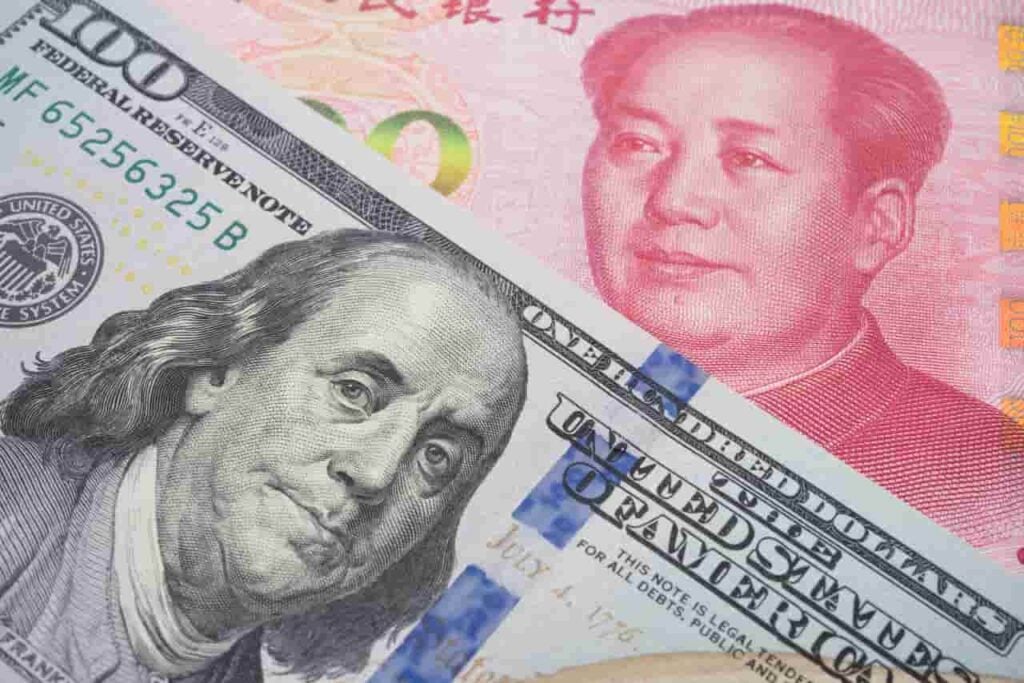
Indeed, Dalio reflected on the recent developments in the Strait of Hormuz pertaining to Iran accepting tolls and selling its oil in Chinese yuan rather than in USD as a sign that the world is undergoing a pivot from its current reserve currency.
According to the billionaire investor, the move might appear like a footnote in 2026, but it is part of a greater 13-step process and will be identified in the future as a major milestone in a journey that will end with Americans having their financial health pummeled.
Dalio warns British savers lost 40% after the Suez Crisis, and Americans will suffer the same after Hormuz tolls
Ray Dalio also warned that the journey is likely to lead to a severe depreciation of the USD and provided the fate of British savers as the U.K. lost its superpower status following the Suez Crisis as a pivotal recent example.
Citing the impact of Iran’s latest decisions, the billionaire investor warned that the outcome is likely to be a significant loss in status for the American dollar, which will, in turn, lead to debt becoming more expensive.
In turn, the need to finance attempts to maintain the country’s status in an increasingly tumultuous world, as well as the ever-rising interest payments, will make rampant money-printing all but compulsory.
Therefore, as Dalio himself pointed out, the devastation likely to impact American households will not be the result of a sudden crisis, but rather the effect of a long-term process of inflation and currency debasement.
Unlike the outcome in the U.K. in the previous century, however, the billionaire investor opined that the decline will be faster in the U.S. and the loss of purchasing power is likely to be more severe than the 40% that the Britons experienced.
Billionaire Ray Dalio urges against investing in U.S. bonds
Critically, along with the developments indicating attempts to maintain USD savings are a poor idea, they also position bonds as a losing investment. Indeed, as Ray Dalio underlined, continuously rising interest rates will ensure that any bonds purchased previously will keep losing value without the yield matching the overall depreciation.
The billionaire investor highlighted that, as high as interest payments on government debt got in the 2020s – 30-year treasuries recently crossed above 5% for the first time since the Great Recession – the actual purchasing power lost is far greater.
Backing the claim, the billionaire discussed how Gold soared more than 140% in the last five years and nearly 40% in the last year, showcasing the actual devaluation of the U.S. currency.

Why the loss of the ‘petrodollar’ will devastate American savers and bond investors
Furthermore, Ray Dalio reflected on the most recent critical developments in what Robert Kiyosaki described as the ‘death of the US dollar’: the importance of the so-called ‘petrodollar’.
The ‘petrodollar’ represents the principle agreed upon between the U.S. and Saudi Arabia that OPEC countries would denominate and trade oil exclusively in the American currency.
The system afforded vast operational flexibility to the U.S. as it guaranteed that every country on Earth had to maintain a reserve of USD or be blocked from acquiring arguably the most important commodity on the planet.
Thus, the ‘petrodollar’ guaranteed demand for the American currency, safeguarding its long-term value and, by extension, provided financial stability to Americans and a relative ease of borrowing to Washington.
Dalio then explained that recent years have seen a substantial shift in how the USD is perceived, noting that after the freezing of Russian assets in the aftermath of the Invasion of Ukraine, multiple major economies decided to reduce exposure.
This move became evident relatively quickly as the price of gold skyrocketed, BRICS – originally Brazil, Russia, India, China, and South Africa – began preparing their own currency, countries began making oil trades in more local currencies, and U.S. treasury yields began rising.
Ray Dalio reveals the loss of ‘petrodollar’ is but a chapter in a 13-step journey
Ray Dalio claims that the changes increasingly evident since 2022 are but a part of a 13-step journey he claims to have uncovered while studying the historical replacements of reserve currencies and the waxing and waning of empires such as the Spanish, Dutch, and British.
As might be expected, the billionaire identified the rise of China from having an economy approximately 15% of America’s at the turn of the century to roughly 70% as the emergence of a credible competitor, thus competing ‘step 1.’
Dalio then identified the intensification of trade conflicts, as seen with President Donald Trump’s deployment of tariffs, as the second step: the one in which the existing hegemon attempts to safeguard its role.
The U.S.’s attempts to restrict China’s access to advanced artificial intelligence (AI) semiconductors, followed by the People’s Republic’s apparent refusal to accept downgraded Nvidia (NASDAQ: NVDA) chips and instead developing internal capacity, is then emblematic of the third step.
How proxy wars show the U.S. is losing its global leadership role
Arguably, moving along with ‘step 3’ is Ray Dalio’s ‘step 4’: the intensification of warfare and proxy warfare. Recent years have, just to name a few, seen a major proxy confrontation in the form of the Ukraine War, U.S. operations targeting Venezuela, Nigeria, and mounting pressure on Cuba, and, clearly, the Iran war.
Curiously, ‘step 8’ is arguably an ongoing process that starts from the fourth step and continues in parallel with the subsequent chapters, considering it is represented by an intensification of proxy conflicts.
Did the U.S. sabotage the USD ‘reserve currency’ by freezing Russia’s assets?
‘Step 5,’ as described by the billionaire investor, reinforces the notion that the journey is not strictly linear. Indeed, it involves the country controlling the reserve currency, weaponizing its status by implementing sanctions and other forms of restrictions.
While such a policy grew more visible after 2022 due to the relative scale of Russia and its economy, Washington has a long history of implementing unilateral and frequently illegal sanctions against various actors around the world.
Still, Ray Dalio lingered on the point underlining the message the freezing of Russian assets sent to countries like China, India, Saudi Arabia, and Brazil – traditionally crucial USD holders – which led them to reduce exposure to improve their own freedom of action in terms of activities that might antagonize the U.S.

How the emerging political blocs undermine the ‘petrodollar’ and the U.S. treasuries
As the previous steps were intertwined at least to some extent, the billionaire investor’s sixth and seventh steps are closely interconnected. According to Dalio, they feature the hardening of alliance blocs and the rerouting of supply chains to complement the political arrangements.
In the current century, this is evident with organizations such as the Shanghai Cooperation Organisation (SCO) and BRICS, but also in the ongoing debate about, on the one hand, strengthening NATO and, on the other hand, implementing a more Gaullist vision of a more closely integrated and more independent Europe.
In the previous century, the waning of the Colonial era saw sharp divisions between factions such as the Entente and the Central Powers, and, later, the Allies and the Axis.
Lastly, the ninth step and the final one that Ray Dalio believes is being actively undertaken appears to be a direct result: the fragmentation of financial and technological systems across the blocs that emerged from the conflict.
A showcase of the trend can, arguably, be found in the parallel development of independent AI models across China and the U.S., the efforts to reduce dependence on American semiconductors in the People’s Republic, and to develop domestic rare earths production in the U.S.
Ray Dalio outlines the destruction of the U.S. dollar
Looking ahead, ‘step 10’ also appears like it is underway as it involves ‘brinkmanship’ between the world’s major powers. President Donald Trump has spent much of his second term either bombing, invading, or threatening countries with multiple promises to return Iran to the ‘stone age,’ representing the starkest example.
Meanwhile, Russia has spent years either explicitly or implicitly threatening the use of nuclear weapons due to the continued Western supply and funding of Ukraine, and something of a game of chicken has been playing out in the South China Sea, with the tenuous status of Taiwan providing the backdrop.
Thus, it comes as no surprise that, for Ray Dalio, subsequent steps involve a direct military confrontation between the powers and the rebuilding of the world in the victor’s image.
Dalio reveals where to invest amidst the ‘petrodollar’s’ decline
Still, it is worth noting that the billionaire investor did not recommend that his listeners and followers flee to the Chinese market.
As Dalio pointed out, the People’s Republic has its own economic problems, and, as in any confrontation, it is difficult to predict the winner at the very onset of a confrontation.
Instead, he urged diversifying across international assets using vehicles such as the Vanguard Total International Stock ETF (VXUS), but also investing in commodities such as Gold.

Finally, he noted that another safe bet comes in the form of companies involved in commodity production with a special focus on precious metals, oil, and food, as the price pressure from the decline of the USD is likely to lead to greater revenue and profits for these corporations.
Featured image via Shutterstock