
Casper Network (CSPR) is a Layer-1 proof-of-stake blockchain built for regulated real-world asset tokenization and the machine economy. This review covers its core features, a detailed breakdown of the nine-initiative Casper Manifest roadmap, how to get started, and what to know about safety and regulatory standing.
What is Casper Network?
Casper Network (CSPR) is a Layer-1 proof-of-stake blockchain targeting regulated real-world asset tokenization and machine-to-machine commerce. The network runs a multi-VM execution layer, currently supporting WebAssembly smart contracts with EVM compatibility in the pipeline, and enforces fixed transaction costs at the protocol level rather than through gas auctions.
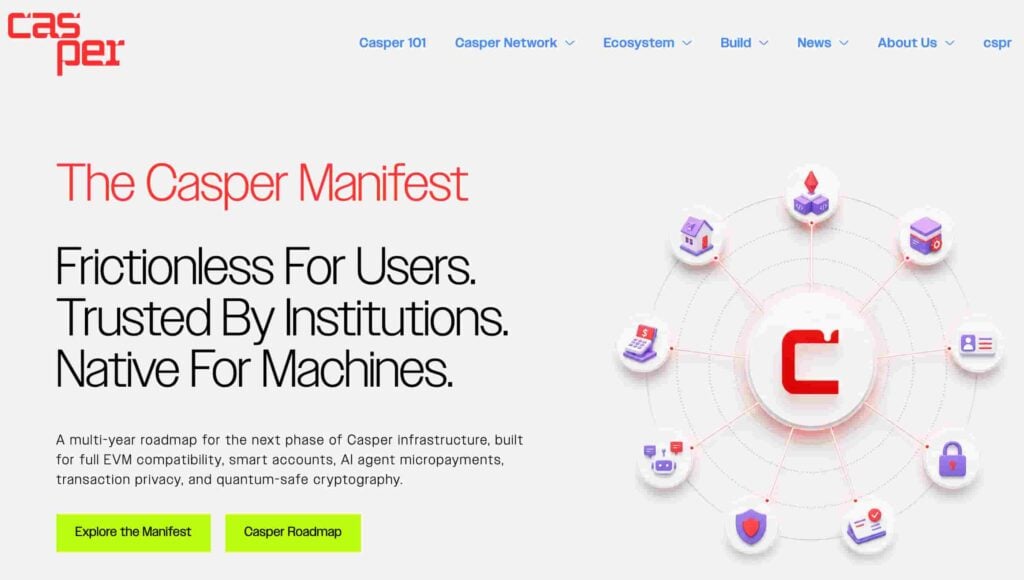
Development is guided by the Casper Manifest, a multi-year technical roadmap covering nine protocol initiatives across developer tooling, user experience, institutional compliance, transaction privacy, micropayments, and quantum safety.
Casper Network core features
Casper’s current feature set is largely defined by what shipped with Casper 2.0. Below are the five core components of the network’s architecture:
- Zug consensus: Zug is a deterministic consensus protocol developed to replace Casper’s original Highway consensus. Where Highway introduced complexity and latency under certain conditions, Zug reduces computational overhead and finalizes blocks faster. Importantly, it allows the network to skip consensus rounds when conditions allow, meaning uncontested blocks do not have to go through a full consensus round before being finalized. The result is instant, irreversible finality, i.e., once a block is finalized, it cannot be reversed, which Casper argues is a prerequisite for real-world asset transfers where ownership must be clear at the moment of transaction;
- Native access control: Casper 2.0 brings role-based permissions directly into the network itself, meaning every action can be tied to specific accounts and enforced by the system at runtime. Developers no longer need to rebuild access logic manually for every contract. The system also supports multi-signature execution, allowing weights to be assigned to different participants and requiring a predefined threshold before any action is taken, which is useful for co-owned assets or regulated transactions;
- Upgradable smart contracts: Smart contracts on Casper are natively upgradable, meaning when business logic needs to change or a new regulatory requirement comes in, developers can update the contract while preserving its state and history, with no migrations or disruption for users. Combined with native access control, upgrades can be restricted to designated roles, with every change leaving a transparent on-chain trail.
- Multi-virtual machine (VM) architecture: Casper 2.0 introduced the ability to run multiple execution engines on a single chain, not as a Layer-2 solution or external rollup, but as a native feature made possible by Casper’s modular execution engine. Casper 2.1 activates VM 2.0, the second virtual machine on the network, which introduces a simplified programming model: URefs are removed, payable and transferable entry points are made native, and all code is valid Rust;
- Developer experience: Casper’s WebAssembly (WASM)-based execution engine allows developers to write smart contracts in Rust or any language that compiles to WASM. Software Development Kits (SDKs) for JavaScript, Rust, and Python are available, alongside Odra (Casper’s Rust-based smart contract framework), which offers a modular, test-driven approach to building applications.
Casper 2.1; What changed?: Casper 2.1 followed Casper 2.0, which launched in May 2025, delivering two incremental protocol changes. Block finalization time was halved from 16 seconds to 8 seconds through refinements to Zug consensus, and a fee-burning mechanism was introduced following an on-chain governance vote by Casper validators, permanently removing all transaction fees from circulation while leaving validator rewards intact.
Casper Network roadmap
Casper’s development is structured around the Casper Manifest, a multi-year technical roadmap organised into nine initiatives across four broad areas: developer access, user experience, institutional infrastructure, and the machine economy. Each initiative carries a status (progress or planned) with target windows spanning 2026 and 2027.
Developer access
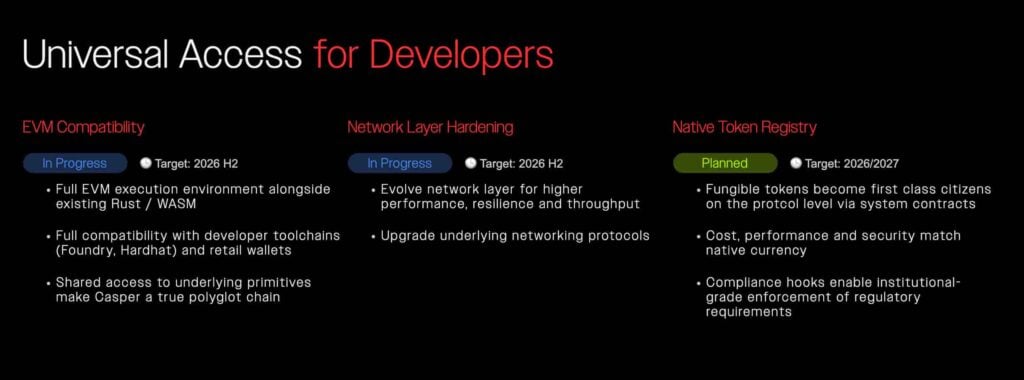
EVM compatibility is currently in progress, with a target of later in 2026. The goal is to allow Ethereum-native smart contracts and tooling to run on Casper without modification, expanding the pool of developers who can build on the network without learning a new stack.
Network layer hardening is targeting the same window, covering improvements to peer-to-peer communication, node resilience, and the underlying infrastructure that keeps the network stable under load.
A native token registry is planned to follow, elevating every user-created token to protocol-level status with the same fixed, predictable costs as native transfers — applicable across both WebAssembly and EVM execution environments.
User experience
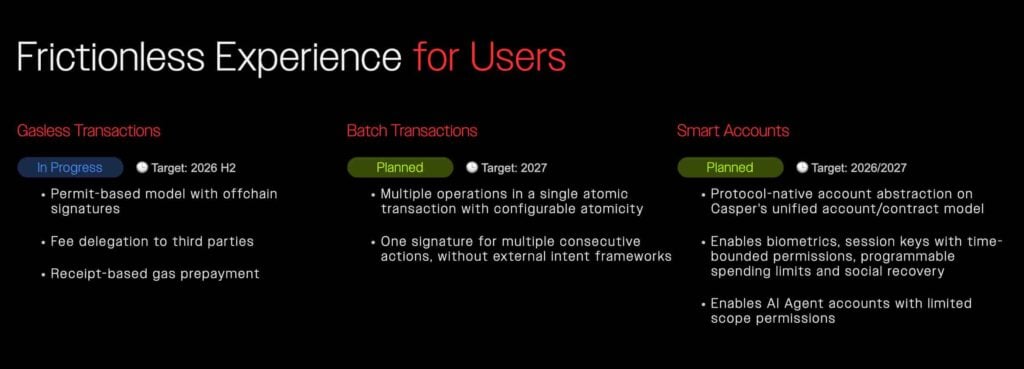
Gasless transactions, batch operations, and smart accounts are grouped as a single phase on the roadmap, following the 2026 EVM and compliance releases.
Gasless transactions allow third parties to cover fees on behalf of users; batch operations collapse multiple steps into a single action; and smart accounts introduce biometric authentication, so interacting with a blockchain application requires no management of cryptographic keys.
Institutional infrastructure
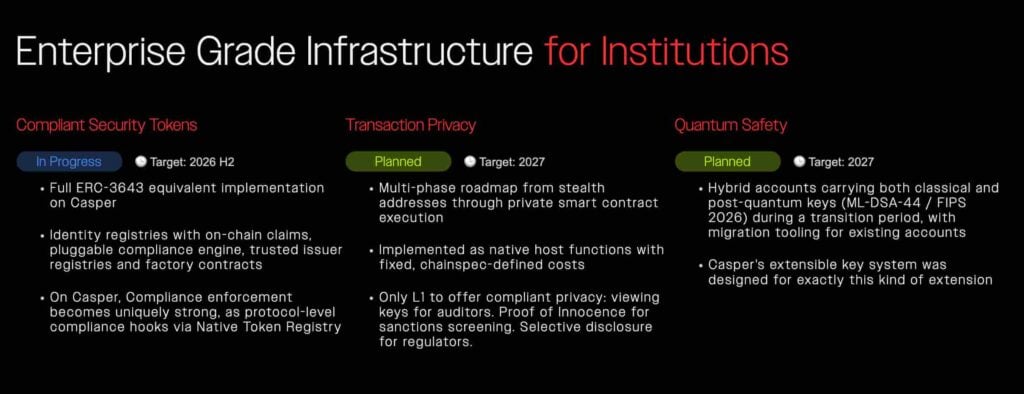
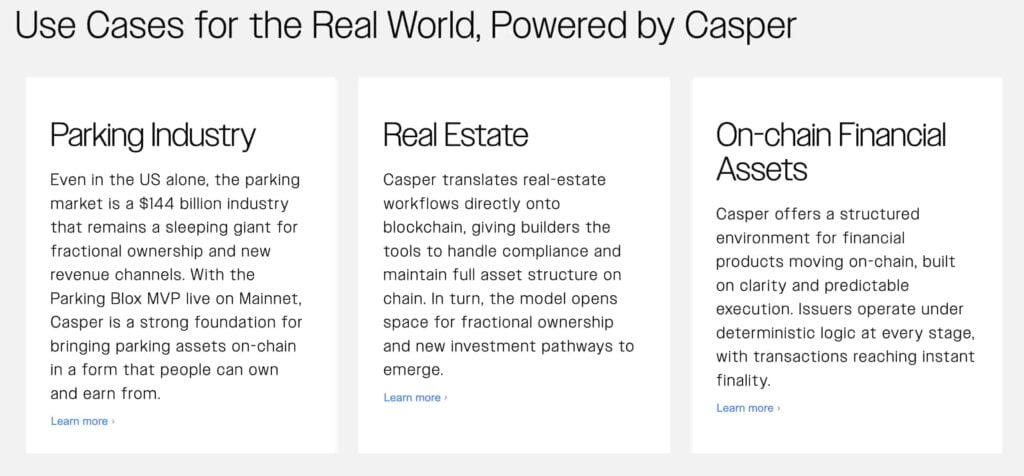
Compliant security tokens are in progress for later in 2026, built in alignment with the ERC-3643 standard, which already governs $28 billion in tokenized assets on-chain. Casper Association is a member of the ERC-3643 Association.
Transaction privacy and quantum safety follow as longer-term initiatives building through 2027.
On privacy, the roadmap delivers confidential transactions with fixed costs and built-in tools for auditors and regulators to verify compliance without exposing transaction details publicly. On quantum safety, the approach uses hybrid accounts carrying both classical and quantum-resistant keys during a transition period.
The machine economy
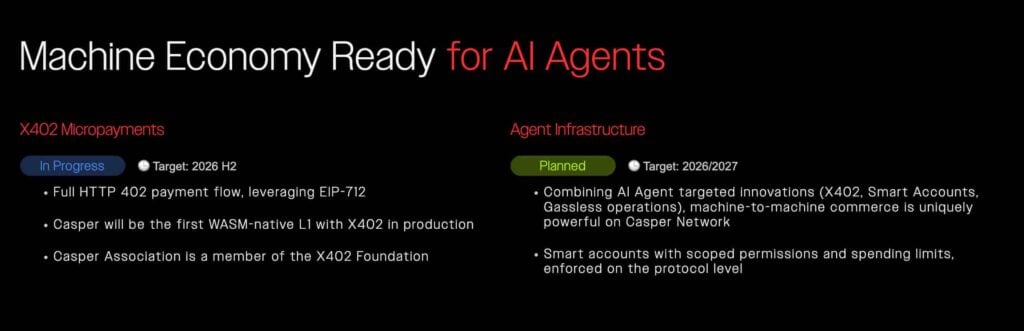
X402 micropayments is the first initiative to ship, expected within weeks of the Casper Manifest’s publication in May 2026. Casper is a member of the X402 Foundation and expects to be the first WebAssembly-native Layer-1 with production X402 support, enabling AI agents and autonomous software to make and receive payments natively over HTTP without human intervention.
Agent infrastructure follows as a longer-term initiative, building out identity, permissioning, and execution logic specific to autonomous systems.
How to get started on Casper Network
For those new to the network, Casper offers a series of step-by-step guides and explainers designed to help users explore and start using the blockchain. All setup guides are available directly on the Casper website. Below is an overview of the key steps to get up and running:
- Setting up a wallet: Casper Wallet is a self-custodial wallet available as a browser extension for Chrome, Firefox, Edge, and Brave, and as a mobile app for iOS and Android. When creating an account, users receive a public key and a secret recovery phrase, which is the only way to recover the wallet if access is lost. The phrase should be written down and stored offline; it should never be shared or saved digitally;
- Getting CSPR: CSPR can be purchased directly through built-in on-ramp options available via cspr.live and Casper Wallet, without needing to go through an external exchange. Both interfaces allow users to select an amount, choose a local currency, and pick from a list of supported fiat on-ramp providers, each of whom handles identity verification and payment processing independently;
- Staking: CSPR holders can earn rewards by delegating their tokens to a validator through cspr.live or Casper Wallet. The validator does not control the delegated funds; the user earns a share of the validator’s block rewards. When choosing a validator, key factors to consider include performance score, commission rate, total stake size, and governance participation. Users should keep at least 2.5 to 3 CSPR in their wallet to cover transaction fees;
- Undelegating and redelegating: Undelegating can be done via cspr.live or Casper Wallet. After undelegating, users must wait 14 to 16 hours before their tokens are liquid again. Users can also redelegate directly to another validator without fully undelegating first; the same waiting period applies;
- Naming your account:CSPR.name is the official naming service on the Casper Network, allowing users to replace their long hexadecimal account address with a human-readable alias such as alice.cspr. Each name is represented as a non-fungible token (NFT) controlled by the owner. Pricing varies by character length: five or more characters cost 250 CSPR per year, four characters cost 750 CSPR per year, and three characters cost 5,000 CSPR per year;
- Buying and selling CSPR names: CSPR names can be traded on CSPR.market. Users can list their names for sale, make offers on names that are already taken, and buy names that have been listed. When an offer is accepted, the token transfers automatically to the buyer and the CSPR amount is deposited to the seller’s account;
- Providing liquidity on CSPR.trade: Users can provide liquidity on CSPR.trade by depositing tokens into a shared pool that supports trading on the platform. Liquidity providers earn a share of the fees generated by swaps, proportional to their share of the pool. Both tokens in a chosen pair must be held before adding liquidity. Users should be aware that providing liquidity involves impermanent loss, which occurs when token prices change relative to each other;
- Liquid staking: Liquid staking on Casper is handled through Wise Lending. Users stake CSPR and receive sCSPR in return, a liquid token that represents their staked position. The exchange rate between sCSPR and CSPR increases over time as staking rewards accumulate. sCSPR can currently be used for swaps on CSPR.trade. Unstaking converts sCSPR back to CSPR, subject to a seven-era waiting period of approximately 16 hours.
Is Casper Network safe?
The Casper Association (the non-profit overseeing the network’s development, registered in Zug, Switzerland since February 2021) has filed a crypto-asset white paper in accordance with Title II of EU Regulation 2023/1114, commonly known as MiCA.
On security, the white paper states that the Casper Association ensures network security through regular audits, open-source software, a bug bounty program, and cryptographic and consensus protocols. Key audit outcomes include verification of the Correct-by-Construction (CBC) implementation’s correctness, identification and resolution of potential vulnerabilities, and confirmation of compliance with enterprise-grade security standards.
The network operates on a public, permissionless distributed ledger maintained by a decentralised network of independent validators. Multi-signature functionality is built natively into the protocol, allowing granular security access through weighted keys and action thresholds.
On the legal side, any disputes are governed by Swiss law, with the exclusive jurisdiction of the ordinary courts in Zug. CSPR is not covered by investor compensation schemes under EU Directive 97/9/EC, nor by deposit guarantee schemes under Directive 2014/49/EU.
On sustainability, energy consumption data is sourced from the Crypto Carbon Ratings Institute (CCRI). Annual energy consumption stands at 58,906.15 kWh, with 35.24% from renewable sources and zero scope 1 emissions.
Casper Network community and support
Casper Network provides support and community resources across several channels. Developers and users can access step-by-step documentation via the Casper docs, which covers everything from getting started to technical protocol references. For direct community engagement and quick feedback, Casper operates an active Discord server and a Telegram group. A dedicated community forum is also available for more in-depth technical discussions and governance participation.
For those looking to follow network updates, Casper is present across the following platforms:
General enquiries can be directed to the Casper Association via the contact page on the website.
Disclaimer: The content on this site should not be considered investment advice. Investing is speculative. When investing, your capital is at risk.
FAQs about Casper
What is Casper Network?
Casper Network (CSPR) is a Layer-1 proof-of-stake blockchain built for regulated real-world asset tokenization and machine-to-machine commerce.
What is the Casper Manifest?
The Casper Manifest is Casper’s multi-year technical roadmap, covering nine protocol initiatives across developer access, user experience, institutional compliance, and the machine economy, with target windows spanning 2026 and 2027.
What is CSPR?
CSPR is the native utility token of the Casper Network. It is used to pay transaction fees, stake to secure the network, and participate in governance decisions.
How do I get CSPR?
CSPR can be purchased through built-in on-ramp options via cspr.live or Casper Wallet, or through exchanges including Bitstamp, Bybit, KuCoin, OKX, and others.
What is instant finality on Casper?
Once a block is finalized on Casper, it cannot be reversed. This is achieved through Zug consensus, which finalizes blocks immediately with no probabilistic delay, a requirement for real-world asset transfers where ownership must be clear at the moment of transaction.
How does Casper support real-world asset workflows?
Casper allows smart contracts to encode layered permissions, shared control, and explicit access rights. Native access control and multi-signature support ensure each party acts only within their authorized role. Upgradable contracts mean compliance logic can evolve without disrupting existing history.
Is Casper Network regulated?
The Casper Association has filed a crypto-asset white paper in accordance with Title II of EU Regulation 2023/1114 (MiCA), with Ireland designated as the home member state and 29 EU and EEA countries as host member states. Any disputes are governed by Swiss law, under the exclusive jurisdiction of the courts in Zug, Switzerland. CSPR is not covered by investor compensation schemes or deposit guarantee schemes under EU law.