
Cregis is a digital asset infrastructure platform that helps businesses build wallet operations, orchestrate fund flows, and manage digital assets at scale. Its product suite spans Wallet-as-a-Service (WaaS), payment engine, operational controls, and compliance-ready infrastructure. This review covers its full product suite, security and compliance standing, who it is built for, and how it compares to alternatives.
What is Cregis?
Cregis is an enterprise-grade digital asset infrastructure provider founded in 2017. The platform delivers MPC-based self-custody wallets, Wallet as a Service (WaaS) solutions, and a Payment Engine, built around collaborative asset control and a compliance-ready ecosystem.
To date, Cregis has served over 4,000 institutional clients globally, safeguarded more than $300 billion in crypto transactions, The company operates five offices across Hong Kong, Dubai, Singapore, Kuala Lumpur, and Sao Paulo, with coverage across 50+ countries.
Notable clients include Bison Bank, Eddid Financial, ATFX, MH Markets, Interlace, 4Alpha Group, and Luxtak. The company is led by founder and CEO Shawn Yan, an early blockchain industry pioneer with over a decade of experience in enterprise technology.
What sets Cregis apart
Cregis positions itself around five core strengths that have helped it serve more than 4,000 businesses globally across digital asset, fintech, payments, and financial services sectors. Below is a breakdown of each:
- Enterprise-grade security: Security sits at the foundation of the platform. Cregis combines MPC (Multi-Party Computation), Trusted Execution Environments (TEE), and Hardware Security Module (HSM) technologies to protect digital assets without relying on a single point of failure. The platform is certified under SOC 2 Type I, SOC 2 Type II, ISO/IEC 27001:2022, providing enterprises with a security framework aligned with institutional requirements;
- Built on real-world operational experience: Unlike many infrastructure providers built primarily around technology, Cregis has refined its products through more than nine years of supporting over 4,000 real business deployments. Its infrastructure is used by exchanges, fintech companies, digital banks, payment service providers, forex brokers, OTC firms, and Web3 businesses, shaping a product experience designed around practical operational needs rather than theoretical workflows;
- Compliance-ready by design: Cregis is purpose-built for regulated and audit-ready digital asset operations. KYT (Know Your Transaction) and KYA (Know Your Address) screening are integrated into the platform, alongside role-based permissions, configurable approval workflows, and full audit trails. This helps businesses implement risk-based controls and maintain operational transparency across digital asset activities;
- Flexible infrastructure for different business models: The platform supports a wide range of use cases, from wallet infrastructure and treasury management to collections, payouts, and digital asset operations. Through its APIs, SDKs, and modular architecture, businesses can customize deployments based on their own operational, compliance, and user experience requirements;
- Cost-efficient enterprise deployment: Cregis aims to lower the barrier to enterprise adoption by reducing the need to build and maintain complex blockchain infrastructure in-house. Businesses can launch digital asset services faster while benefiting from predictable pricing models and a significantly lower total cost of ownership compared with developing similar capabilities internally.
Cregis products and services
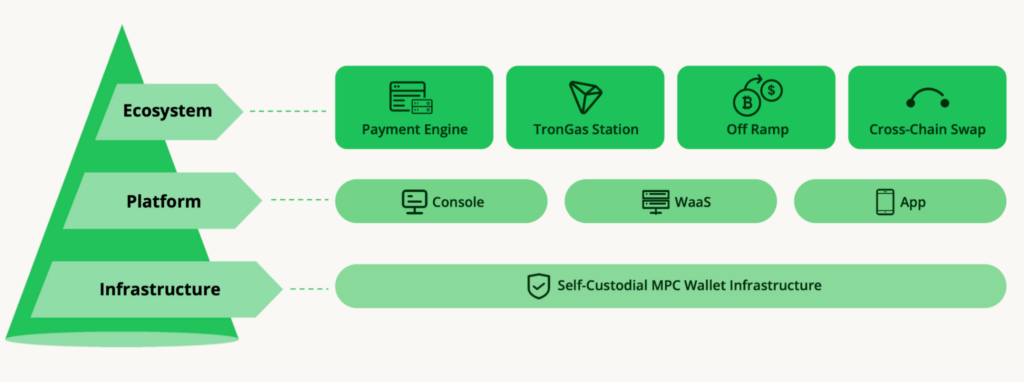
Cregis is structured around three layers: a Self-Custodial MPC Wallet infrastructure at the base, a platform layer comprising the Console, WaaS, and mobile app, and an ecosystem layer of modular services including the Payment Engine, TronGas Station, Cross-Chain Swap, and Crypto Off-Ramp. Below is a breakdown of each component.
Self-Custodial MPC Wallet
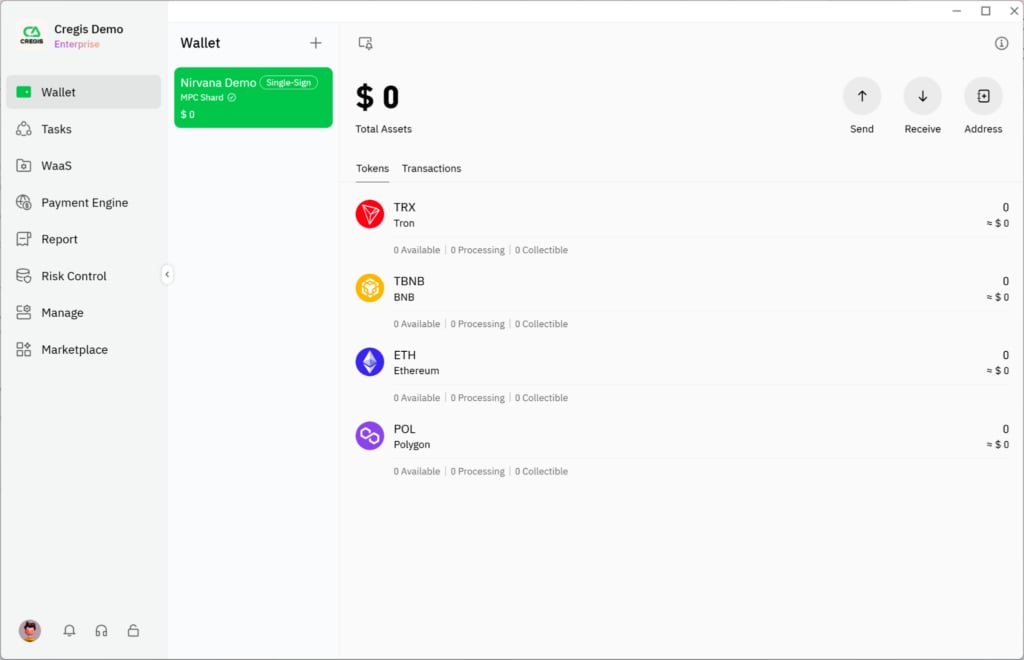
The Self-Custodial MPC Wallet is Cregis’s core infrastructure product. It uses Multi-Party Computation (MPC) technology to manage private keys as distributed fragments across multiple devices and Trusted Execution Environments (TEE), so no complete key ever exists in a single location.
On the governance side, the wallet includes a configurable Policy Engine that routes transactions based on risk level. Payments below a defined threshold can be automatically approved, while larger transactions are routed through multi-level review. For example, to a finance department and then a senior signatory. All transaction activity is monitored in real time with full fund flow visibility.
The diagram below illustrates how the Policy Engine routes transactions based on a value threshold.
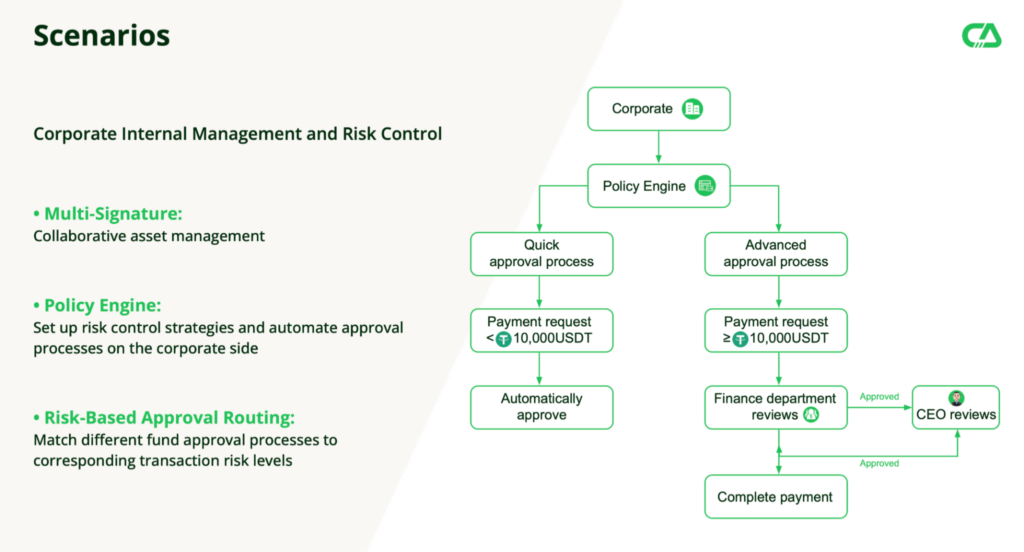
AML compliance is handled through KYT and KYA protocols, with risk-based approval routing that flags suspicious activity automatically. The wallet supports both single-signature and multi-signature configurations, and covers asset management across 40+ blockchain networks.
Wallet as a Service (WaaS)
Cregis WaaS extends the MPC wallet infrastructure via API and SDK. Businesses can integrate wallet functionality into their own platforms through a RESTful API designed for setup in under 10 minutes, with automated address management and real-time transaction monitoring included.
Interfaces and branding are fully customizable. The WaaS also supports batch transactions and scales dynamically to match business growth.
WaaS is primarily targeted at exchanges, financial service providers, Web3 projects, and e-commerce platforms.
Payment Engine
Cregis’s Payment Engine is a payment orchestration layer designed for businesses managing digital asset collections, payouts, settlements, and cross-border fund flows. Rather than functioning as a standalone payment gateway, it serves as the operational layer that connects wallets, on-chain transactions, fund collection, payouts, treasury management, and settlement workflows into a single system.
At its core, Cregis Payment Engine is designed to help businesses build and scale digital asset operations. It supports the full lifecycle of fund movement, from receiving and managing assets to executing payouts, reconciling transactions, and settling funds across different networks and counterparties.
It supports T+0 settlement, meaning funds are settled in real time with no waiting period, and operates 24/7 with a stated critical issue response time of two hours.
The diagram below illustrates the full payment flow, from customer checkout through to business settlement.
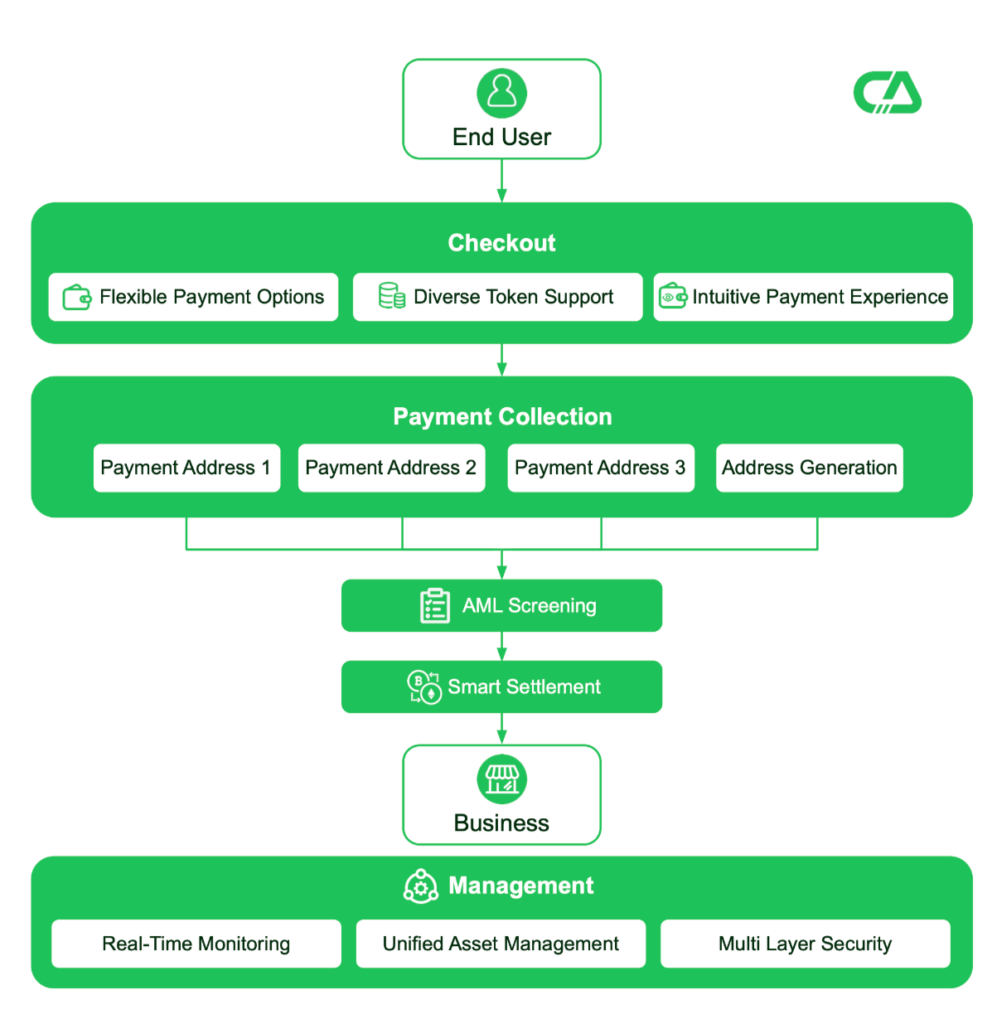
The payment flow covers checkout, payment collection via dynamically generated addresses, AML screening, and automated settlement into designated business accounts. Risk controls include behavioral analysis, blacklist screening, and automated isolation of high-risk addresses.
Integration is available through APIs and SDKs, allowing businesses to embed collection, payout, and settlement capabilities into e-commerce platforms, marketplaces, fintech applications, exchanges, and other digital asset products. The engine also includes automated handling of overpayments, underpayments, and transaction reconciliation to reduce operational overhead.
Ecosystem built for Stablecoin Transactions / Enterprise Operations
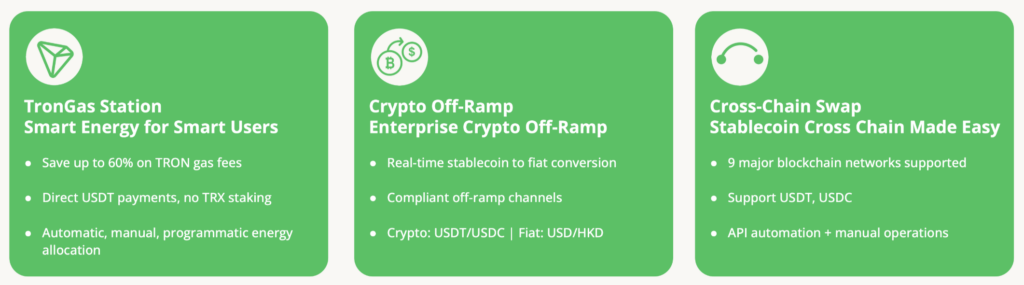
Alongside its core wallet and payment infrastructure, Cregis offers three modular ecosystem tools designed to address specific operational needs.
TronGas Station
TronGas Station is an energy proxy service for the Tron network, designed for businesses that process high volumes of transactions on Tron. It is available as a standalone service and does not require a Cregis wallet. Gas fees are paid directly in USDT with no TRX staking required, and Cregis states businesses can save up to 60% on Tron gas costs.
The service offers three proxy methods: Smart Proxy, Self-Service Bulk Proxy, and API Proxy, with pay-per-use and bulk-purchase pricing options. Users are billed only for actual energy consumed.
Cross-Chain Swap
Cross-Chain Swap helps businesses rebalance liquidity across blockchain networks without relying on multiple external bridge providers, simplifying treasury and settlement operations. It supports USDT and USDC across nine major blockchain networks, with both API automation and manual operation options available.
Crypto Off-Ramp
The Crypto Off-Ramp provides a compliant channel for converting stablecoins to fiat. Supported crypto assets are USDT and USDC, with fiat settlement available in USD and HKD. Conversion is processed in real time.
Operations Hub
Beyond wallet infrastructure, Cregis provides an operational control layer designed for enterprise digital asset management. The platform combines role-based access control (RBAC), segregation of duties, customizable approval workflows, and a policy engine that allows businesses to automate routine transactions while maintaining oversight of higher-risk activities.
A full audit trail records asset movements, approvals, policy updates, and user actions, helping organizations meet internal governance, compliance, and audit requirements. For many enterprises, these operational controls are as important as wallet security itself, particularly when managing assets across multiple teams and jurisdictions.
Is Cregis safe?
Technical stack
Cregis’s security architecture is built on the GG18 MPC Protocol, under which private keys exist only as distributed fragments across multiple devices and Trusted Execution Environments (TEE).
The platform also employs multi-layer authentication, multi-signature control, transaction analysis-based AML screening, and Trust Vault custody technology. A Hardware Security Module (HSM) underpins the Nexus private deployment product. The WCCIP Protocol is currently in development.
AML screening is handled through integrations with Elliptic and Regtank, covering real-time transaction analysis, KYT, and KYA protocols.
Smart contracts are independently audited by CertiK. The platform is hosted on a multi-layer security architecture built on AWS Cloud with 24/7 monitoring. Cregis states it has maintained a zero security incident track record across nine years of operation.
Security certifications
Cregis holds the following certifications:
- SOC 2 Type I;
- SOC 2 Type II;
- ISO/IEC 27001:2022;
Regulatory and compliance framework
Cregis holds the following regulatory licenses:
- American MSB (Money Services Business)
- Hong Kong Trust or Company Service Provider (TCSP) license
In addition to regulatory coverage, the platform includes KYT and KYA screening, transaction monitoring, approval workflows, role-based access controls, and audit trails designed to support compliant digital asset operations.
It should be noted that the ecosystem services, including the Payment Engine, TronGas Station, Cross-Chain Swap, and Crypto Off-Ramp, are provided through Cregis’s licensed entity in Anjouan and are governed by the laws of that jurisdiction. Users are responsible for ensuring compliance with the laws of their own domicile.
Who is Cregis for?
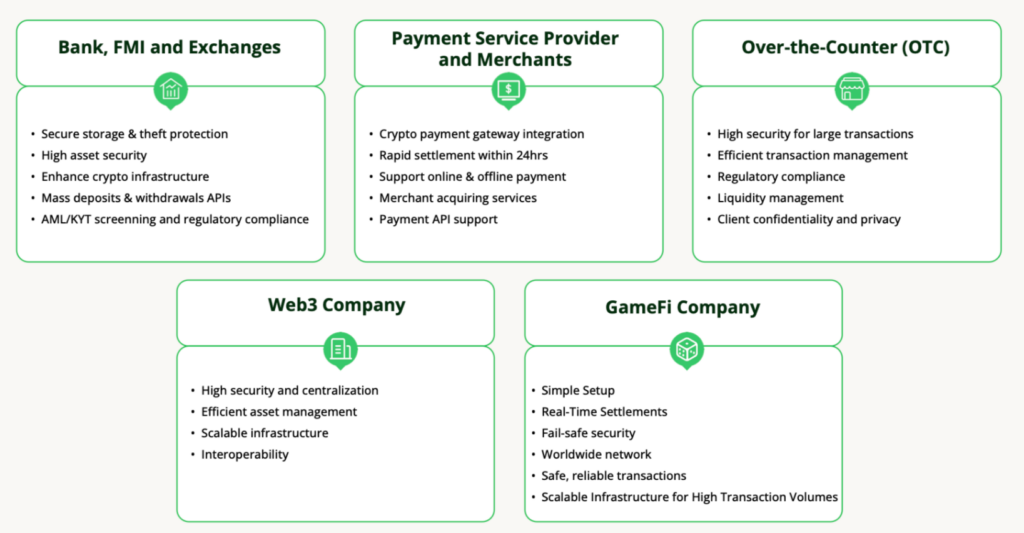
Cregis targets five primary client segments. Below is a breakdown of each:
- Banks, financial market infrastructures (FMIs), and exchanges: Banks and FMIs can integrate cryptocurrency wallet functionality into existing systems via the WaaS API, with custom interface support to maintain brand consistency. The platform provides mass deposit and withdrawal APIs, batch payment processing, configurable transaction approval workflows, and on-chain AML and KYC (Know Your Customer) monitoring. For exchanges specifically, MPC-based asset security, on-chain AML monitoring with real-time risk alerts, and a standardized WaaS API for wallet integration are the primary use cases.
- Forex platforms: Forex platforms are identified as a target segment given their need for cross-border payment infrastructure and stablecoin settlement. The Payment Engine’s support for 17 fiat currencies and T+0 cross-currency settlement is directly relevant here. Several of Cregis’s listed clients, including ATFX, GTCFX, MH Markets, CentFx, and VPFX are forex brokers;
- Payment service providers(PSP) and merchants: Payment service providers and merchants can integrate crypto payment gateway functionality via the Payment Engine, with support for both online and offline payments. T+0 settlement, merchant acquiring services, and Payment API support are the core features for this segment;
- Fintech platforms & embedded finance providers: Fintech platforms and embedded finance providers can use Cregis to integrate wallet infrastructure, stablecoin settlement, and digital asset payment capabilities into existing financial products;
- OTC desks: OTC desks require infrastructure for high-volume transactions with strong compliance controls. Cregis’s wallet provides fund collection across multiple addresses into a single wallet, automated fund allocation, KYT and AML monitoring with real-time policy updates, and client confidentiality through MPC-based key management.
- Web3 companies: Web3 companies can use Cregis’s MPC wallet and WaaS infrastructure to manage on-chain treasuries, handle payroll, and support decentralized finance operations. The platform’s multi-chain support and cross-chain compatibility allow Web3 companies to manage assets across different blockchain networks from a single interface. Besides, Cregis offers a fast and cost-effective self-service token listing solution, ensuring effective support for project tokens.
Cregis vs. competitors
The table below compares Cregis against three established enterprise digital asset infrastructure providers: Fireblocks, BitGo, and Copper. Features marked as available via integrations or third-party partnerships are noted accordingly.
| Feature | Cregis | Fireblocks | BitGo | Copper |
| MPC self-custody | ✅ | ✅ | ✅ (TSS) | ✅ |
| WaaS API | ✅ | ✅ | ✅ | ❌ |
| TronGas optimization | ✅ | ❌ | ❌ | ❌ |
| Cross-chain swaps | ✅ | ✅ (via integrations) | ❌ | ✅ (ClearLoop) |
| Off-ramp | ✅ | ✅ (via integrations) | ✅ (BitGo Prime) | ❌ |
Pros and cons

Pros
- Strong product-market fit in crypto-native and payment-heavy segments: Cregis is more deeply embedded in exchange, OTC, forex broker, and payment-oriented use cases rather than purely institutional custody workflows, making it well-aligned with real transaction-heavy business needs in crypto infrastructure today;

Cons
- Limited public pricing standardization across product modules: While payment processing fees are transparent, pricing for core infrastructure components such as MPC wallets and WaaS is not publicly standardized and typically requires direct enterprise engagement, reflecting a customized enterprise pricing model;
Cregis support and community channels
Cregis offers customer support through its dedicated Product Manual and Help Center, which includes FAQs covering the platform’s core products and features. Support is available 24/7 via live chat and an AI assistant. Businesses looking to explore the platform can request a demo directly at cregis.com/appointment.
For developer-specific queries, full API documentation is available at developer.cregis.com.
Cregis can also be reached via its Telegram channel and Discord community for general enquiries and updates.
The platform is present on the following social media channels:
The Cregis app is available to download for both iOS and Android via cregis.com/download.
Conclusion
As digital asset adoption expands beyond crypto-native businesses into fintech, payments, and traditional financial services, infrastructure providers are increasingly expected to balance security, operational flexibility, and regulatory readiness.
Cregis is an established enterprise digital asset infrastructure platform that offers a modular suite of wallet, payment, and transaction infrastructure solutions. It is particularly relevant for institutional and mid-market clients seeking multi-chain coverage, configurable workflows, and a self-custody–oriented architecture.
There are some limitations to consider. Pricing beyond the Payment Engine is not publicly disclosed, and onboarding typically requires direct engagement with the sales team rather than a self-serve product experience, which may add friction in early-stage evaluation.
That said, for exchanges, payment service providers, forex brokers, OTC desks, and Web3 companies looking for production-ready digital asset infrastructure without building it in-house, Cregis presents a credible and well-positioned option in the current market landscape.
Disclaimer: The content on this site should not be considered investment advice. Investing is speculative. When investing, your capital is at risk.
FAQs about Cregis
What is Cregis?
Cregis is a digital asset infrastructure platform for enterprises, providing the underlying systems to manage wallets, payments, and on-chain transactions. It is designed to help businesses build and operate digital asset workflows without developing blockchain infrastructure in-house.
Who is Cregis for?
Cregis is designed for institutional and enterprise users, including exchanges, payment service providers, fintech companies, forex brokers, OTC desks, merchants, and Web3 businesses that require infrastructure for digital asset operations at scale.
In which countries can I use Cregis products?
Cregis works with clients in over 50 countries. We have people across Asia, the Middle East, Latin America, Europe, Africa and the Americas, with offices in Hong Kong, Singapore, Dubai, Kuala Lumpur, and São Paulo.
Is Cregis safe?
Cregis is built with enterprise-grade security standards, including SOC 2 Type I and II, ISO/IEC 27001:2022, and PCI DSS certifications, along with CertiK audits and integrations with AML providers such as Elliptic and Regtank. It also states a nine-year operational history with no reported security incidents.