
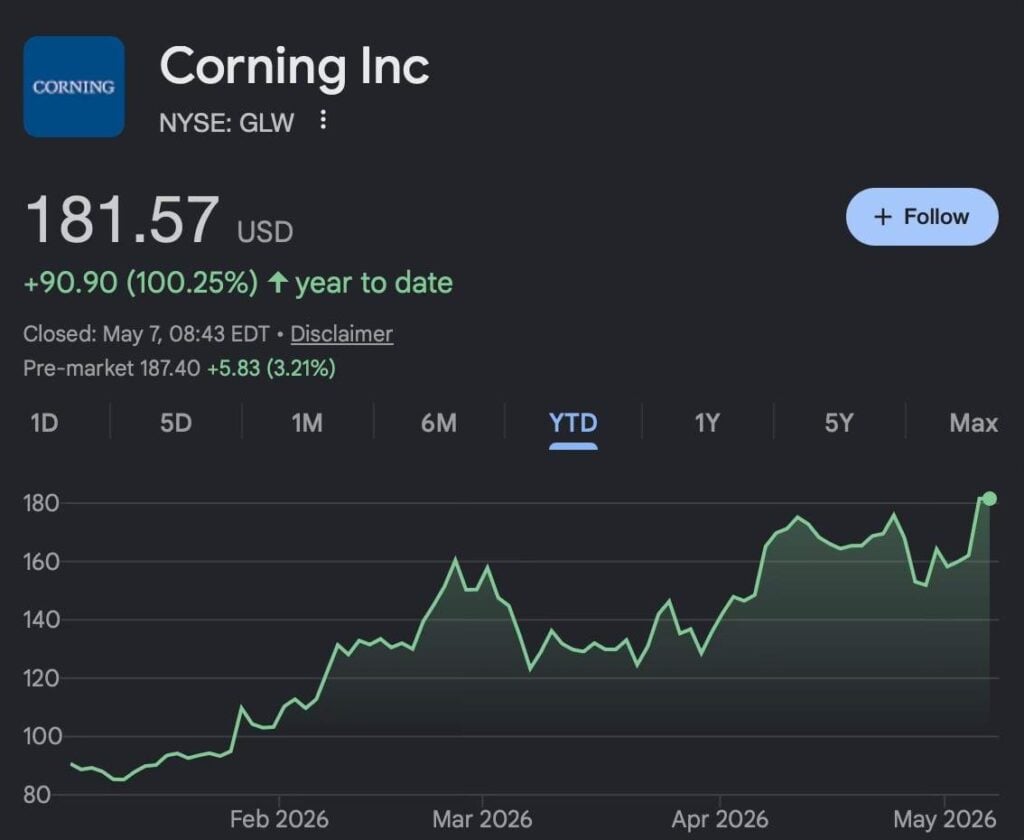
Corning (NASDAQ: GLW) stock soared more than 12% on May 6 and another 3% in-premarket on May 7 following the announcement of a new partnership with Nvidia (NASDAQ: NVDA).
The new deal has sharply raised Corning’s long-term revenue outlook, with a multi-year agreement to expand U.S.-based optical connectivity and data center fiber manufacturing.
As such, the partnership is meant to help the two partners meet surging demand for faster data movement in artificial intelligence (AI). More precisely, Corning plans to increase its optical manufacturing capacity tenfold and expand fiber production by more than 50%.
“Corning will increase its U.S.-based optical connectivity manufacturing capacity by 10x and expand its U.S. fiber production capacity by more than 50% to meet the accelerating demand driven by AI factory buildouts,” the management wrote in the initial press release.
At the time of writing, GLW shares were sitting at $187.4 in pre-market trading, up more than 100% year-to-date (YTD) and vastly outperforming Nvidia.
Nvidia to purchase 18 million GLW shares
Further, three new advanced manufacturing facilities will be built across North Carolina and Texas, a move expected to create roughly 3,000 jobs.
“Together with Corning, we are inventing the future of computing with advanced optical technologies – building the foundation for AI infrastructure where intelligence moves at the speed of light while advancing the proud tradition of Made in America,” Jensen Huang added.
As part of the deal, Nvidia has also received warrants to purchase up to 18 million Corning shares in a transaction valued at $500 million.
That includes warrants for 15 million shares priced at $180 each, along with pre-funded warrants for an additional 3 million shares at a nominal price.
Nvidia CEO Jensen Huang described the agreement as a “once-in-a-generation opportunity to reinvigorate American manufacturing,” adding that the companies are “inventing the future of computing with advanced optical technologies.”
Overall, Corning now expects to reach $20 billion in annualized sales by the end of 2026, representing a 15% compound annual growth rate from late 2023 levels. What’s more, it targets $35 billion in annualized revenue by 2030, up from a previous $27 billion goal for 2028.
Featured image via Shutterstock